What to Record After Every Sales Call (and How to Stop Typing It)

The short answer
After every customer conversation, record five things: the buyer's pain at every level, the competition, the deal process and who else needs to be involved, why they're buying now, and something personal about your champion. Capture the buyer's exact words, then add your own read on what they meant.
It matters more than most teams think. In an anonymized dataset of 1,802 closed B2B opportunities from one sales team, deals with more than 70% of MEDDPICC substantively filled in were about 15 times more likely to close than deals under 40%. That's a correlation, not proof, but it's a big enough gap to change how you think about the notes after a call.
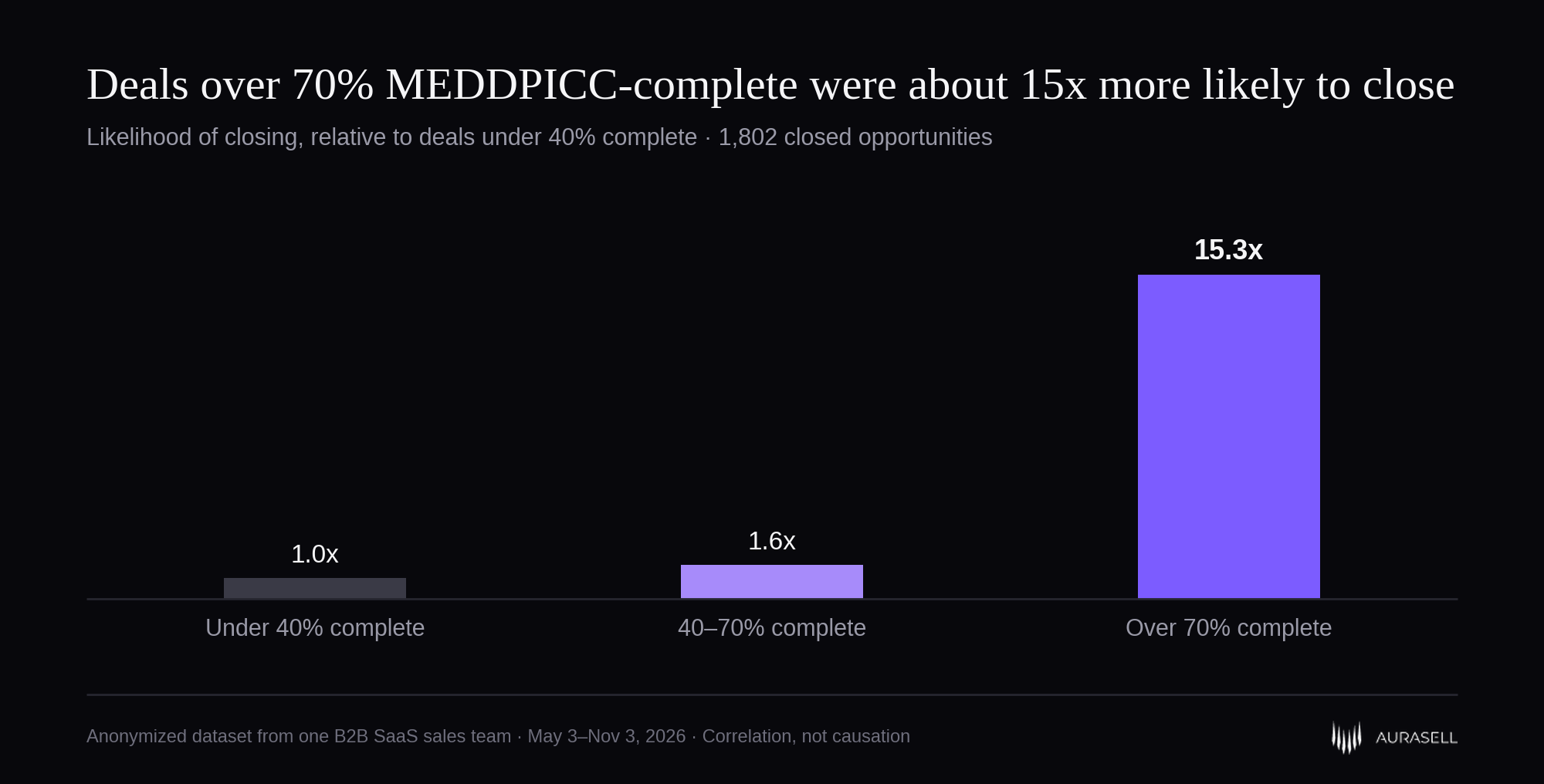
Anonymized dataset from one B2B SaaS sales team · 1,802 closed opportunities, May - November 2026 · completion across seven MEDDPICC elements, strict measure · relative close rates shown; correlation, not causation
The problem is that almost nobody records these things consistently. Here's what to capture, what gets skipped, and how to stop relying on reps to type it all up.
What one missed signal cost us
I work in RevOps and Growth. I'm on a handful of customer calls a week, but every week I listen back to far more of them, looking for signals that a deal is stalling and what that means for pipeline.
One deal still sticks with me. It was in a proof of value, and the signals were clear: the champion was meeting with competitors. The rep didn't address it for three to four weeks. By the time they did, the deal had slipped two to three months and out of the quarter.
Nothing about that was hidden. The signal was in the conversations. It just never made it into the record where someone would act on it.
That's not a one-off. In the dataset behind this post, substantive information about the competition was missing on almost 90% of 578 open opportunities.
And when competition was on the record, it was a warning worth heeding. Deals with competition substantively recorded were 2.8 times as likely to have their close date pushed into a later quarter than deals without it. That's my slipped deal in the data: competition is an early sign a deal may move, which is exactly why it can't sit unrecorded for three weeks.
The five things to record after every call
If a rep could only write down five things after a call, these are the ones I'd pick:
- Pain, at every level. First-order pain is the problem the buyer names out loud. Second-order pain is what that problem costs the business. Third-order pain is what it means for the buyer personally, like their credibility or their next promotion. Most notes stop at the first.
- Competition. Who else they're talking to, and how seriously. This is the one that cost us a quarter.
- The deal process, and who else needs to be involved. How they buy, who signs, and which stakeholders haven't shown up yet.
- Why now. What's forcing a decision this quarter instead of next year. Without it, a deal can stall forever without ever being lost.
- Something personal about your champion. What they care about, what they mentioned in passing. It's what keeps a relationship warm between calls, and what the next rep needs most if the deal changes hands.
The dataset backs up most of this list. Deals where these details were actually on the record closed far more often than deals where they weren't:
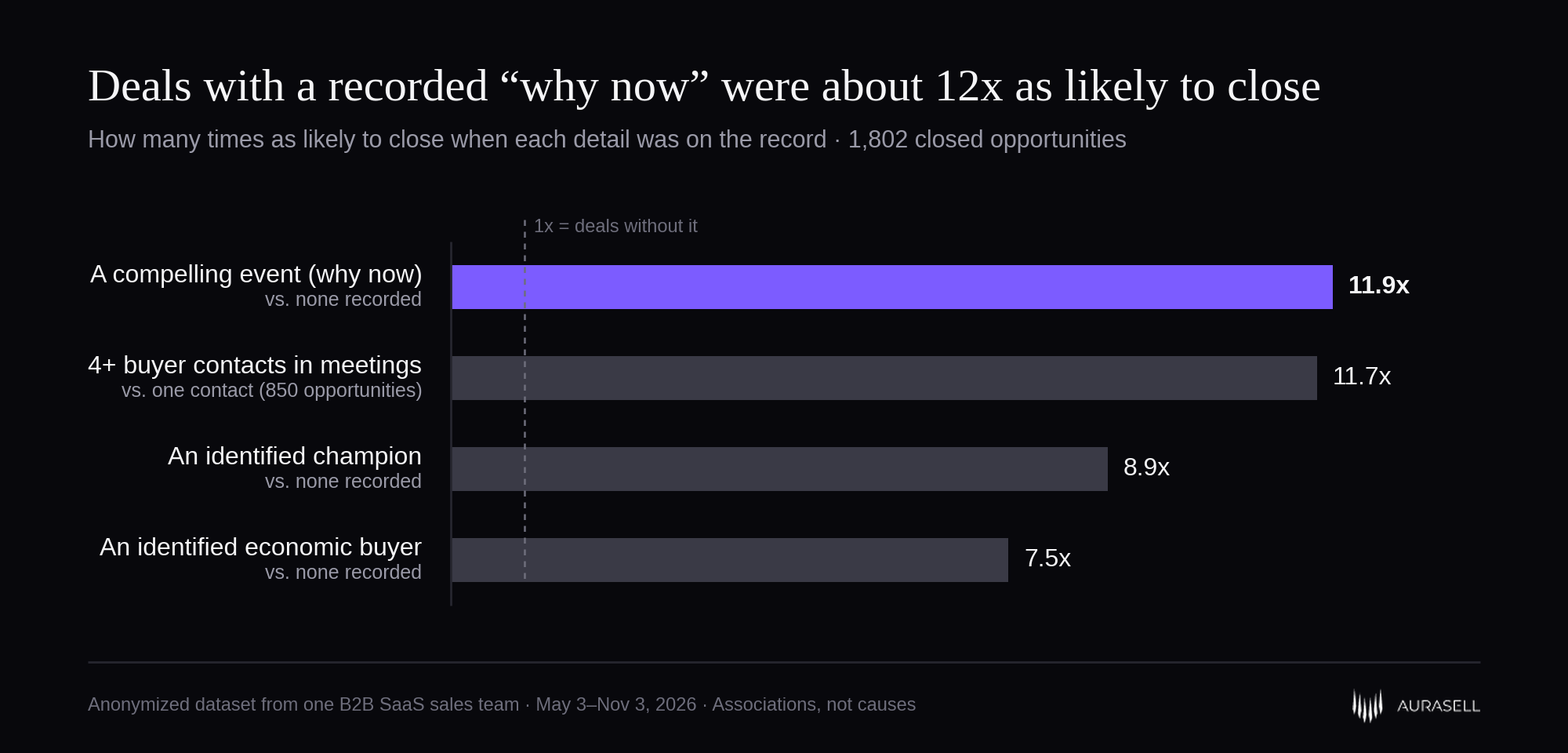
Anonymized dataset from one B2B SaaS sales team · 1,802 closed opportunities (multi-threading: 850 with measurable meeting contacts), May 3–November 3, 2026 · associations, not causes
None of these prove that writing something down wins the deal. Strong deals naturally produce a clear why now and more people in the room. But they're exactly the details that tell you whether a deal is real, and they're the ones that go missing first.
When I've inherited a deal, the thing I always wished I had was the context from earlier calls and the pain those buyers were feeling. You lose trust immediately when you can't keep the ball rolling and stay on the same page as the Economic Buyer and champion.
Record the exact words, then your interpretation
The buyer's exact quote always matters. "We lost two reps last quarter because they couldn't hit ramp" tells you far more than "pain: onboarding." Then add the context around it in your own words: what you think they meant, how strongly they felt it, and what it means for the deal.
What changes by call type
The signals are the same on every call: pain, competition, and the 3 Whys (why anything, why now, why us). What changes is the context you're listening for.
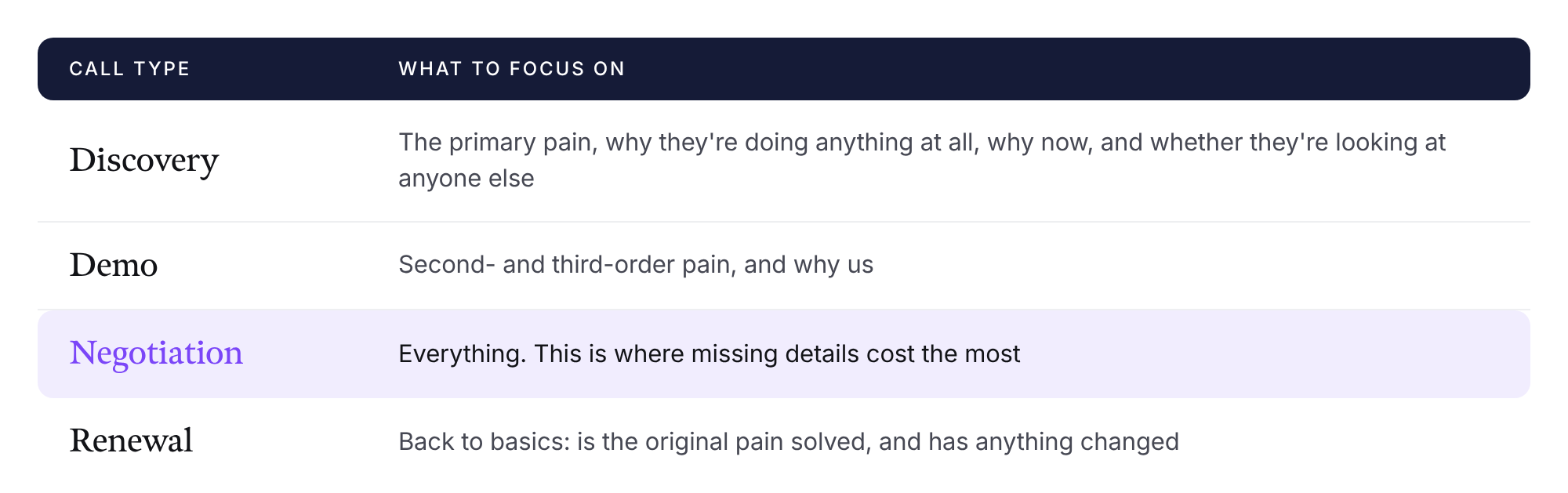
We run MEDDPICC, the 3 Whys, and Sandler on top of this. The frameworks give the notes structure, but they only work if the information actually gets recorded.
What teams skip
In the dataset, the same MEDDPICC elements get skipped that I see on calls every week.
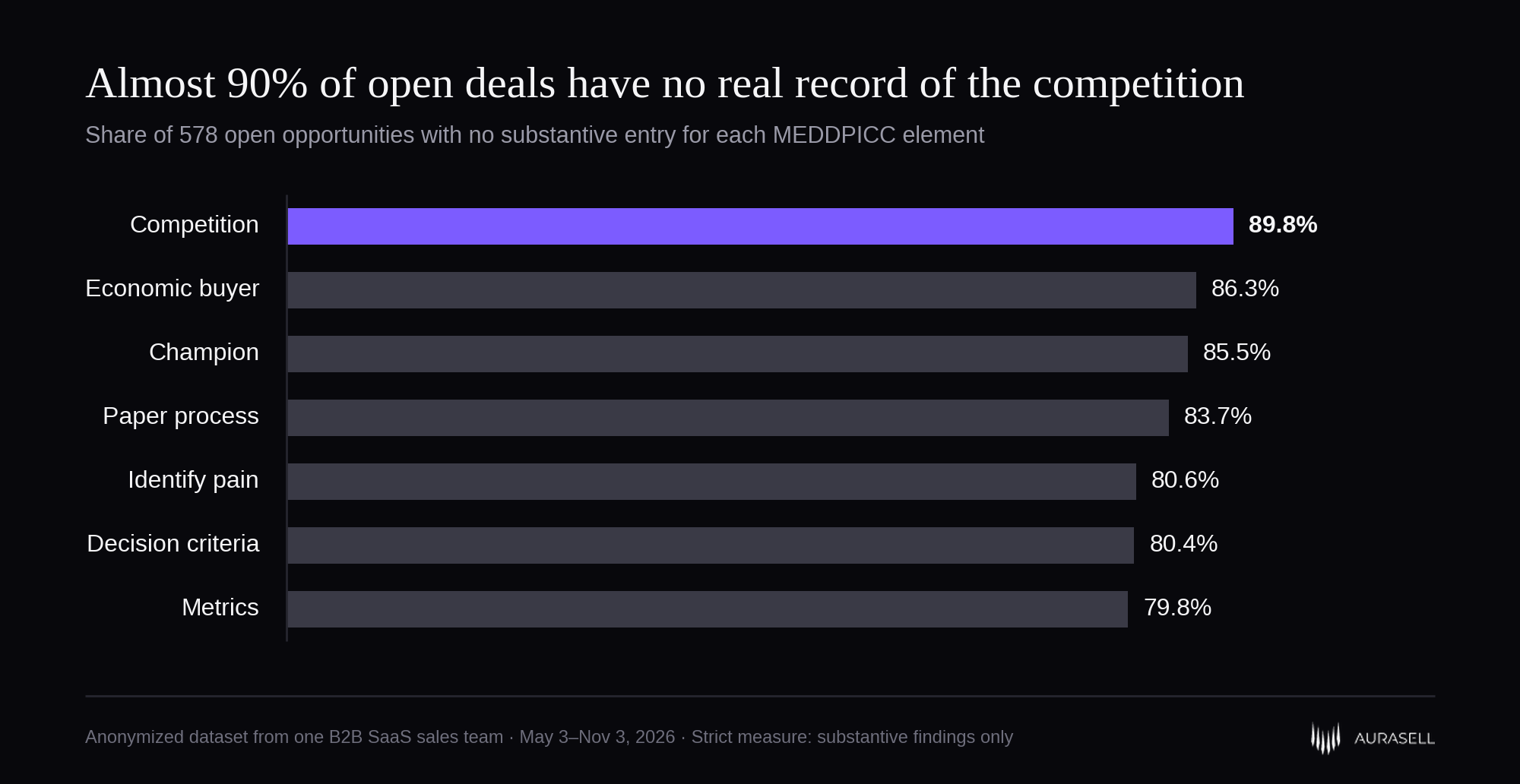
Anonymized dataset from one B2B SaaS sales team · 578 open MEDDPICC opportunities, as of November 3, 2026 · strict measure (substantive findings only)
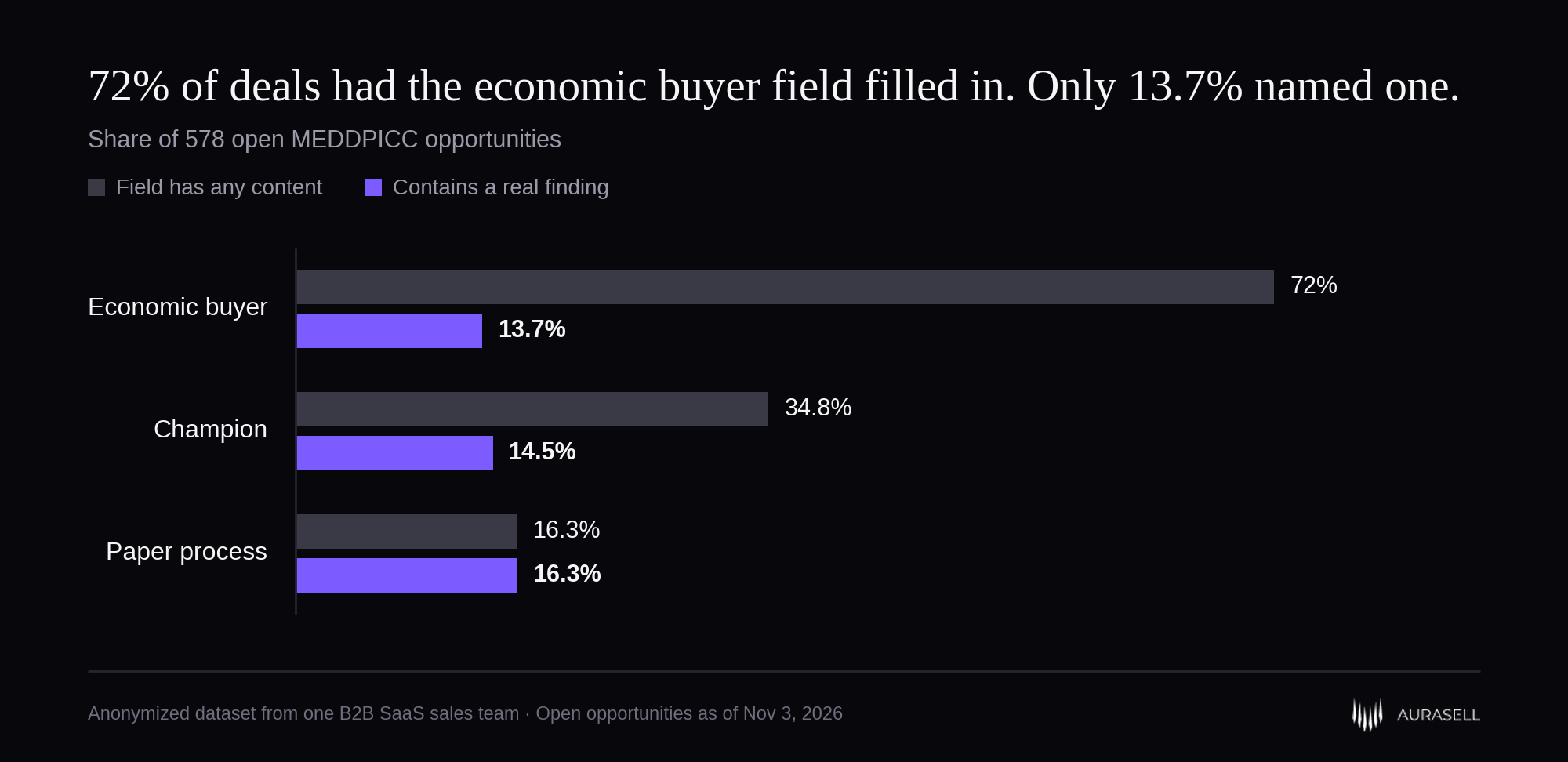
A filled-in field isn't the same as a recorded fact, either:
Anonymized dataset from one B2B SaaS sales team · 578 open MEDDPICC opportunities, as of November 3, 2026
Paper Process is the odd one out: when the field is filled in at all, it holds a real finding. It's just almost never filled in.
Gaps in the record also show up as deals that quietly go dark:
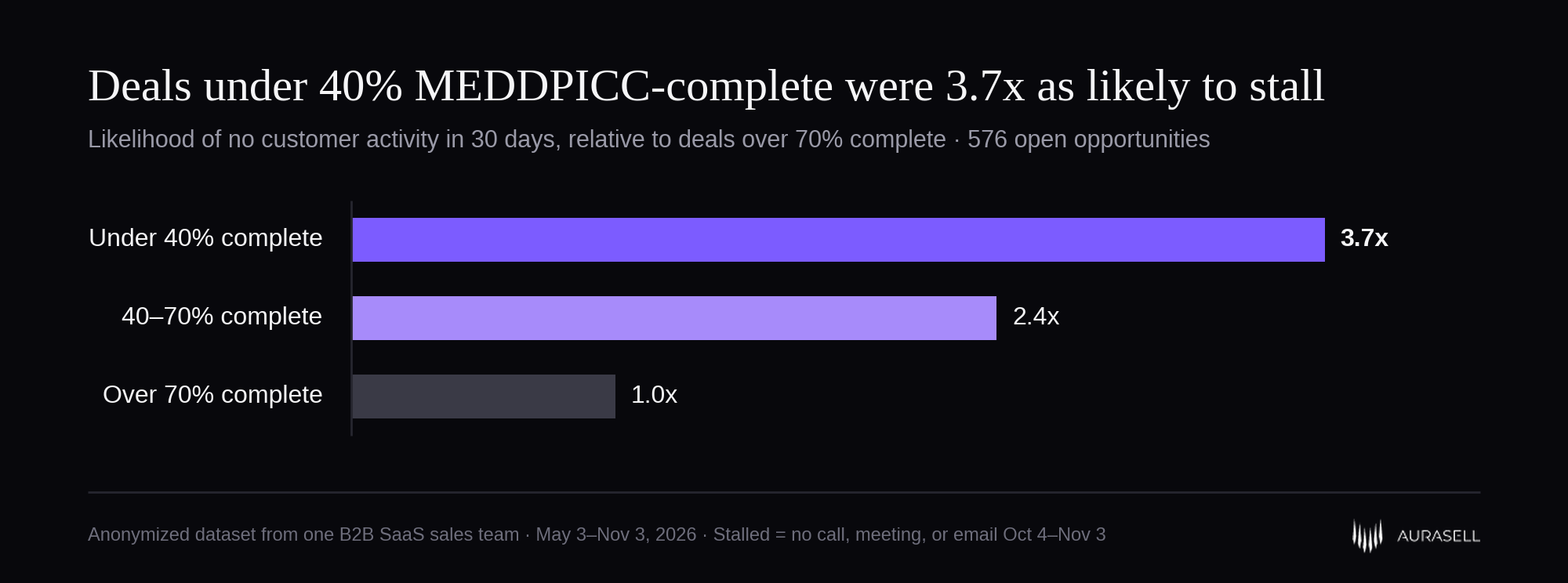
Anonymized dataset from one B2B SaaS sales team · 576 open opportunities · stalled = no customer-facing call, meeting, or email from October 4 to November 3, 2026
And here's my unpopular opinion: teams obsess over deal stages, and they matter far less than people think. A stage is a label someone picks. The pain, the competition, and the people involved are what tell you where a deal really stands.
Why reps don't log it
The honest answer: they have more important things to do. Logging a call properly takes a rep 20 to 30 minutes by my estimate, depending on how good they are. And there's a lot to log. In the dataset, the typical closed-won deal involved 5 meetings, 51 emails (automated sequence emails included), and 67 customer touches before signature.
We tried everything to fix it: mandatory fields, stage gating, managers nagging, rule-based automation in the old CRM, Slack reminders. None of it actually fixed anything. Rules can't hear what a buyer said, and reminders don't make a rep remember a call from three days ago.
Let the conversation update the CRM
The CRM should be updated by what the buyer said, not what the rep remembers.
Rule-based automation couldn't do that, but AI that reads the conversation itself can. In the dataset, where calls and emails were captured automatically, the work split like this:
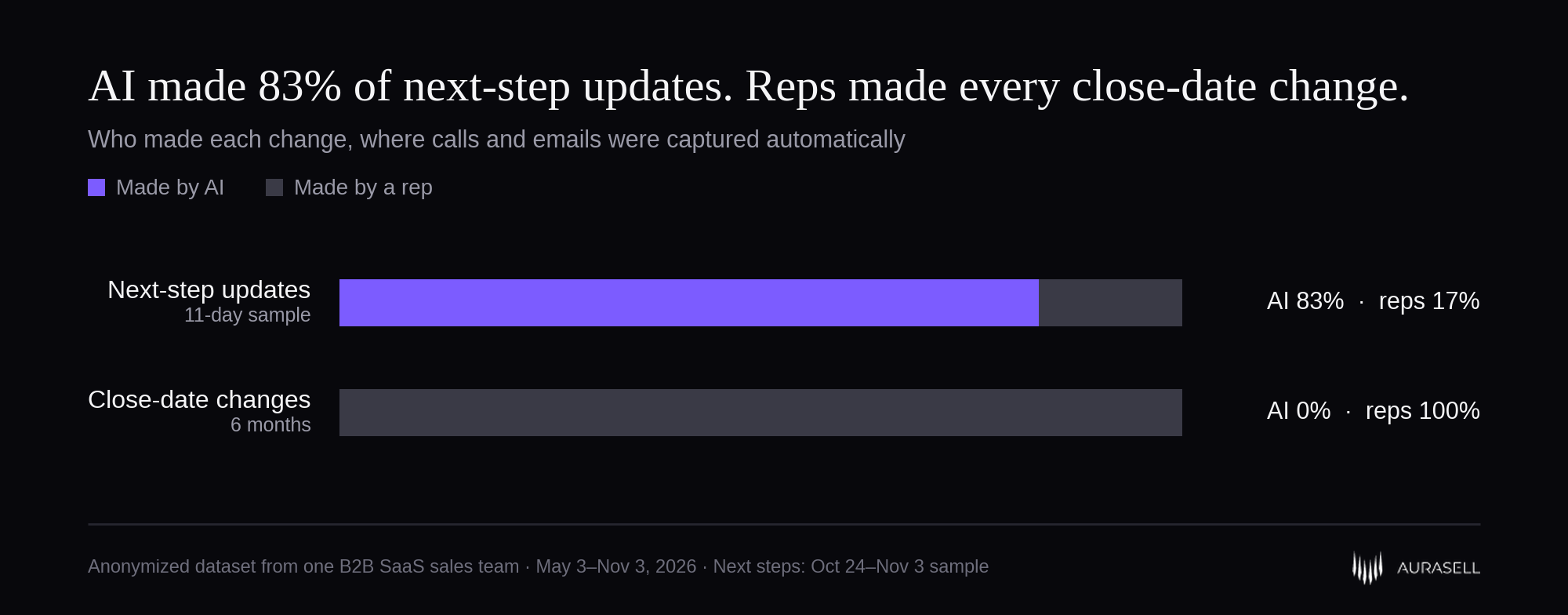
Anonymized dataset from one B2B SaaS sales team · next-step updates from an Oct 24–Nov 3, 2026 sample; close-date changes from May 3–Nov 3, 2026
In practice, AI keeps the record of what happened current, and the rep still makes the call on when a deal will close.
When the notes take care of themselves, managers don't have to manage reps' admin anymore. Reps manage their own work, and they spend the time on selling. Even next steps get easier. I don't think there's one right format for writing them; whatever works for the rep and their manager is the right one, as long as it's actually there.
That's the problem Aurasell is built to solve. Aurasell is an AI-Native Revenue OS that records every customer conversation, pulls out the pain, competition, people, and next steps, and updates the deal automatically, including scoring MEDDPICC from what buyers actually said.
About the data
The figures in this post come from an anonymized dataset of one B2B SaaS sales team's CRM and conversation records from May 3 to November 3, 2026: 1,802 closed opportunities and 578 open ones that use MEDDPICC.
An element counts as complete only when the record holds a substantive finding, like a named Economic Buyer, rather than any text at all. The link between completion and closing is a correlation, not proof that filling in MEDDPICC wins deals, and the most-complete group is the smallest, at 54 deals. Close rates are shown relative to each other rather than as absolute percentages.
Each comparison was measured within the same dataset: Champion, Economic Buyer, and compelling-event figures across all 1,802 closed opportunities; multi-threading across the 850 with measurable meeting contacts; close-date slips across 2,217 opportunities with usable history, 85 of them with competition recorded; and stalls across 576 open opportunities over the final 30 days.
FAQ
What information should sales teams record after customer conversations to improve pipeline management?
Record five things: the buyer's pain at every level, the competition, the deal process and who else needs to be involved, why they're buying now, and something personal about the champion. Capture the buyer's exact words, plus your read on what they meant. In an anonymized dataset of 1,802 closed B2B opportunities, deals with more than 70% of MEDDPICC substantively filled in were about 15 times more likely to close than deals under 40%.
Which deal details are most linked to winning?
In an anonymized dataset of 1,802 closed B2B opportunities, a recorded compelling event ("why now") was linked to deals about 12 times as likely to close, and having 4 or more buyer-side contacts in meetings to about 12 times, compared with one contact. A substantively identified Champion was linked to about 9 times, and an identified Economic Buyer to about 7.5 times. These are associations, not causes.
What should you capture after a discovery call compared with a demo or a renewal?
The signals are the same (pain, competition, and why anything, why now, why us), but the focus shifts. Discovery is about the primary pain and why now. A demo is about deeper pain and why you. Negotiation needs everything. A renewal goes back to whether the original pain is solved.
How do I stop reps from manually logging emails and calls into the CRM?
Capture them automatically from email, calendar, and call recordings, and let AI update the deal from what was said. Mandatory fields, stage gates, and reminders add pressure but rarely fix the problem, because they still depend on a rep remembering the call.
Can AI keep my pipeline current by updating deals from emails and meetings?
Yes. In an anonymized dataset where calls and emails were captured automatically, AI made 83% of next-step updates in an 11-day sample, while reps still own judgment calls like close dates. The key is that the AI reads the conversation itself, not a set of rules.
Which MEDDPICC elements get skipped most often?
In an anonymized dataset of 578 open opportunities, Competition, Economic Buyer, and Champion were the most often missing, each with no substantive entry on more than 85% of opportunities.