


Every Sales and RevOps team has felt this. You have a big problem, so you review internal process to identify gaps and inefficiencies. A clear gap in capability is identified, so you start looking at technology to solve your problem.
You buy a new point solution that fills 80-90% of your issues, and then spend the next 3+ months building integrations and processes to ensure onboarding and operationalizing this new tool is smooth. As you operationalize these tools, it creates an additional layer of complexity that requires more headcount, more cost, or more frustration that causes usage to drop.
As your environment becomes more complex, frustrations continue to rise and you start the cycle again. So our goal was to identify what those key frustrations were and provide you with options on how to solve them.
Scope and methodology
Our goal of this blog is to identify the top pain points of Sales and RevOps leaders. The internal context used includes anonymized Aurasell customer research, business-value assessments, implementation materials, product documentation, and deal evaluations. It provides direct evidence of recurring GTM-stack problems among organizations evaluating or adopting Aurasell. External research is used only to add broader market context and supporting benchmarks; it does not replace the internal evidence.
The ranking below reflects the frequency, severity, and strategic importance of these themes in the internal context. The exact order is directional rather than a universal industry ranking.
*Pulled from internal research at Aurasell and external research
What we have found at Aurasell
1. Tool sprawl is the clearest recurring problem
The strongest internal pattern is not simply that companies have many tools; it is that their tools have become difficult to operate as a coherent GTM process.
Examples include:
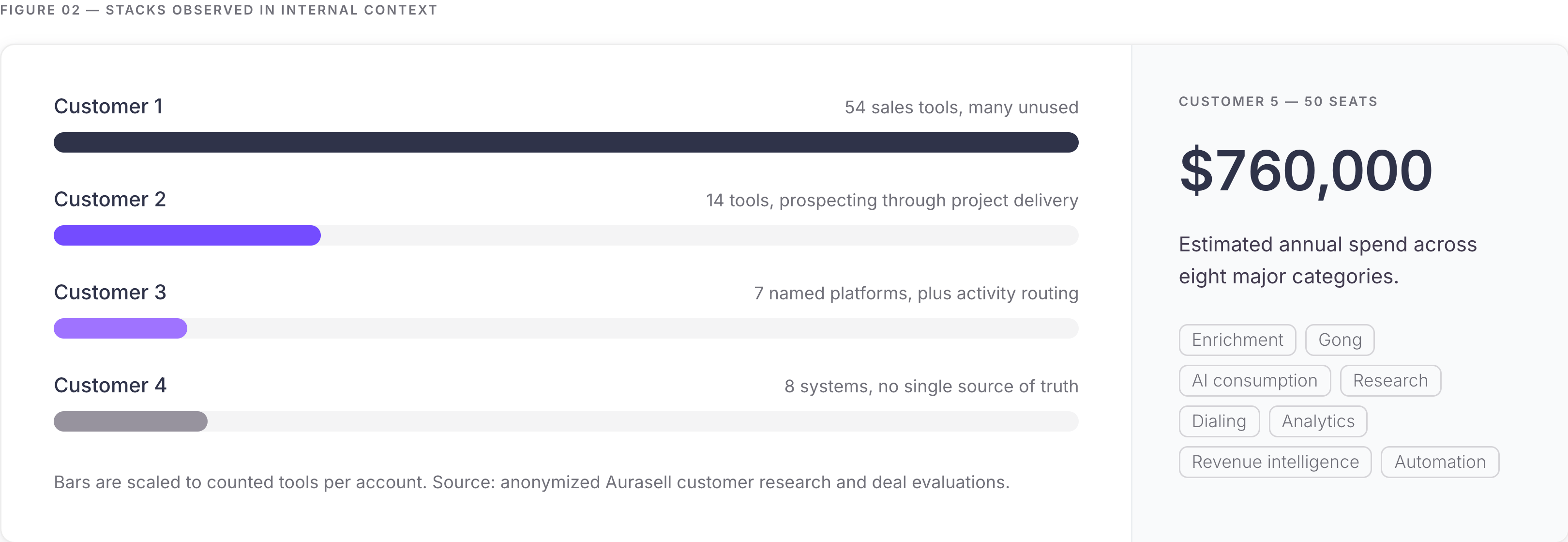
- Customer 1: 54 sales tools, many unused.
- Customer 2: 14 tools across prospecting, sales execution, and project delivery.
- Customer 3: Salesforce, Salesloft, Gong, Clari, ZoomInfo, and Highspot, plus complex partner and end-customer activity-routing requirements.
- Customer 4: Salesforce, Gong, Clari, Apollo, Clay, People.ai, BI tools, and workflow engines, without a single source of truth.
- Customer 5: A 50-seat stack with estimated annual spend of $760,000 across eight major categories.
This indicates that leaders dislike the cumulative operating model: multiple contracts, multiple data models, multiple interfaces, and multiple sources of truth.
2. Leaders want activity and intelligence captured automatically
Internal product and customer context repeatedly points to the same expectation: sellers should not have to reconstruct the deal record manually after every interaction.
Aurasell’s internal capabilities address this through:
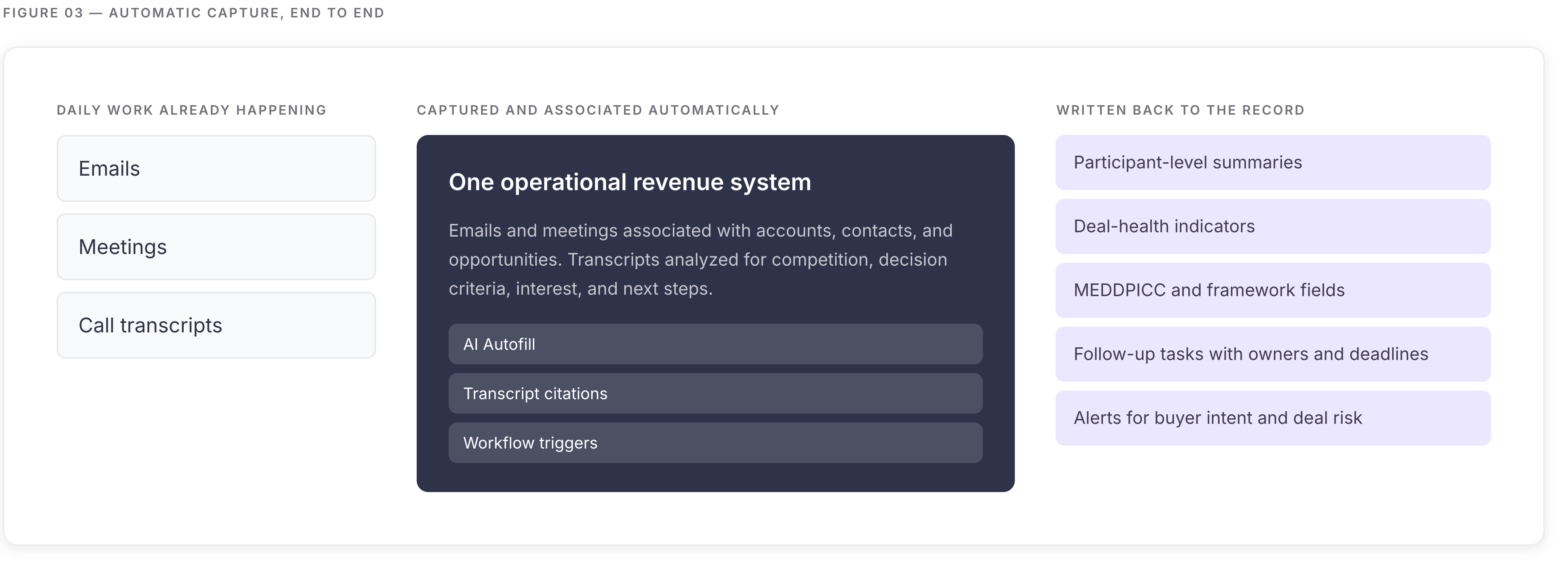
- Automatic association of emails and meetings with accounts, contacts, and opportunities
- Transcript analysis for competition, decision criteria, interest, and next steps
- Participant-level summaries identifying roles, priorities, pain points, and stakeholders
- AI Autofill for deal-health indicators
- Automatic creation of follow-up tasks with owners, deadlines, and transcript citations
- AI-generated MEDDPICC and sales-framework fields
- Workflow-triggered alerts for buyer intent and deal risk
The underlying complaint is that traditional systems ask sellers to record the information that their daily work already contains.
3. Forecasting frustration is both data and process related
The internal context does not frame forecasting as merely a reporting problem. It identifies several connected issues:
- Incomplete meeting and activity data
- Inconsistent sales methodology usage
- Manual spreadsheet-based forecast calls
- Slow analytics and QBR preparation
- Difficulty challenging or refining rep forecasts
- Need for multi-dimensional reporting by region, motion, product, and line of business
- Risk of misinterpreting revenue splits or double-counting
Aurasell’s internal forecasting guidance specifically addresses revenue-split aggregation, daily snapshots, waterfall views, trend analysis, AI forecast insights, and executive overrides.
4. Consolidation is valued because it changes seller behavior
Consolidation is more than a procurement initiative. The goal is to let sellers operate in one environment.
Customer 8, for example, plans to phase in Aurasell over several years, with a near-term goal of replacing Salesloft’s core capabilities and enabling reps to work entirely within Aurasell while initially retaining Salesforce as the CRM.
This reflects a practical concern: replacing a tool is less valuable if sellers still have to maintain the same fragmented workflow elsewhere.
5. AI is valuable only when embedded in revenue workflows
Applied AI rather than generic AI functionality is the focal point. The high-value use cases are tied to specific operating moments:
- Capture the next step after a meeting
- Identify missing decision-makers
- Detect competitive threats
- Score engagement
- Populate qualification frameworks
- Alert managers to deal risks
- Create tasks automatically
- Generate account-level value hypotheses
- Support cross-sell and multi-threading
- Compare AI-generated forecasts with human forecasts
Sales and RevOps leaders are not primarily asking for more AI features. They are asking for fewer manual steps and more reliable execution.
How the internal and external evidence reinforce each other
*Pulled from internal research at Aurasell and external research
The central strategic insight
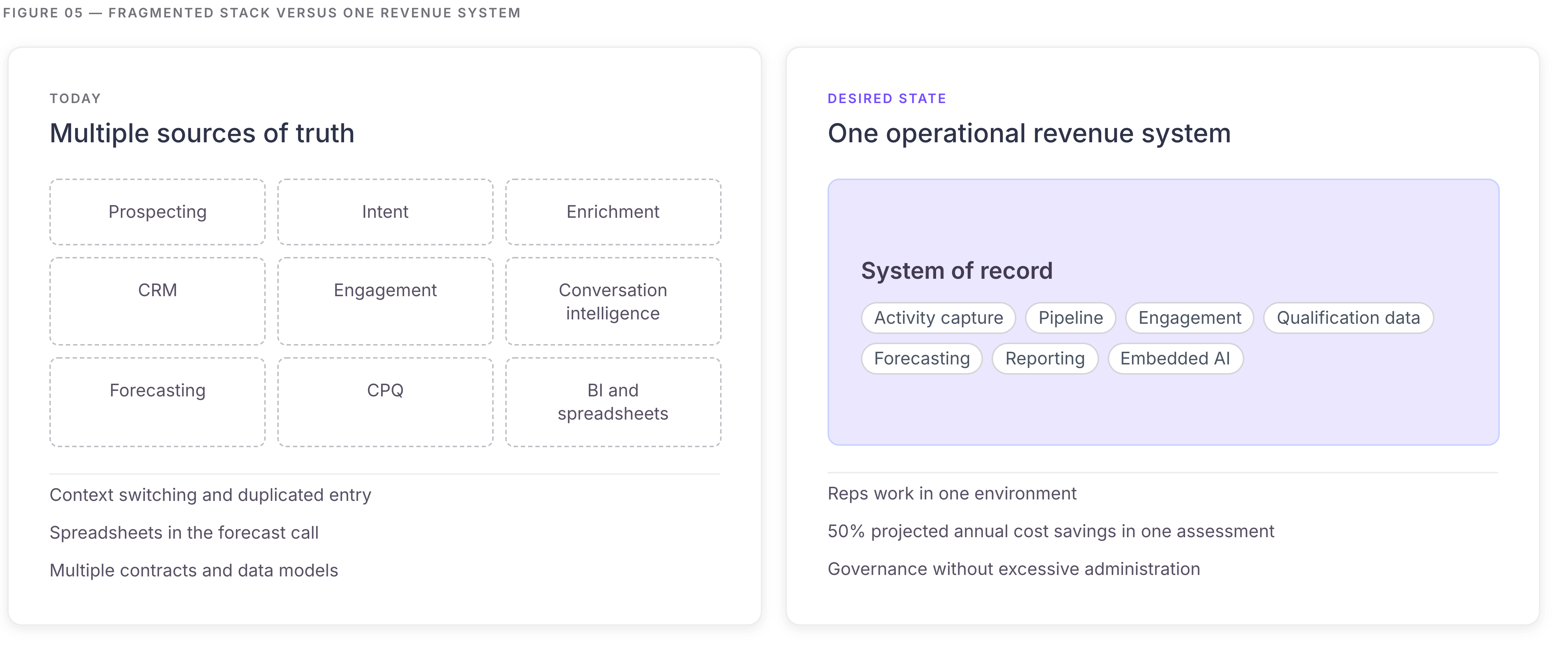
Sales and RevOps leaders do not hate individual tools in isolation. They hate the fragmented operating model created when too many tools, inconsistent data, and manual processes are stitched together.
The recurring desired state is:
- One operational revenue system
- Automatic capture of customer and deal activity
- Consistent sales methodology and qualification data
- Reliable forecasting and pipeline visibility
- Fewer tools and lower operating cost
- AI embedded directly into seller and manager workflows
- Clear governance without excessive RevOps administration
Aurasell’s customer evidence supports this positioning through examples of tool consolidation, improved data capture, forecast automation, workflow adoption, and quantified cost or productivity gains.
*External research confirms that these are not isolated customer complaints but broader GTM technology patterns during 2024–2026.