
Why are we still stitching a dozen GTM tools together?
Why in 2026 does our industry still think it's OK to stitch together a dozen different GTM tools, hire two people to manage those tools, and then spend the rest of the year trying to unify and clean the data across those silos?
The short answer on ROI: one platform beats best-of-breed on two costs, not one. The first is on your invoices: I priced a 14-tool stack for our own team at $423,230 a year. The second never shows up on an invoice: customer data split across 14 databases, which is exactly what stops AI from working.
If you're weighing a single AI-native revenue platform against your current point tools, add up both. Here's how I did it.
The visible cost: $423,230 a year for 14 tools
I recently priced up a GTM stack for our team at Aurasell. We're a 75-person startup with 33 GTM people (14 sellers) and an ICP of roughly 15,000 accounts and ~75,000 contacts in the US and EMEA.
The cost? A mere $423,230 a year, split across 14 tools, and that's before we add anything fancy or AI on top. Yes, I'm sure I could negotiate it down by attending a zillion sales calls, but you get my point.
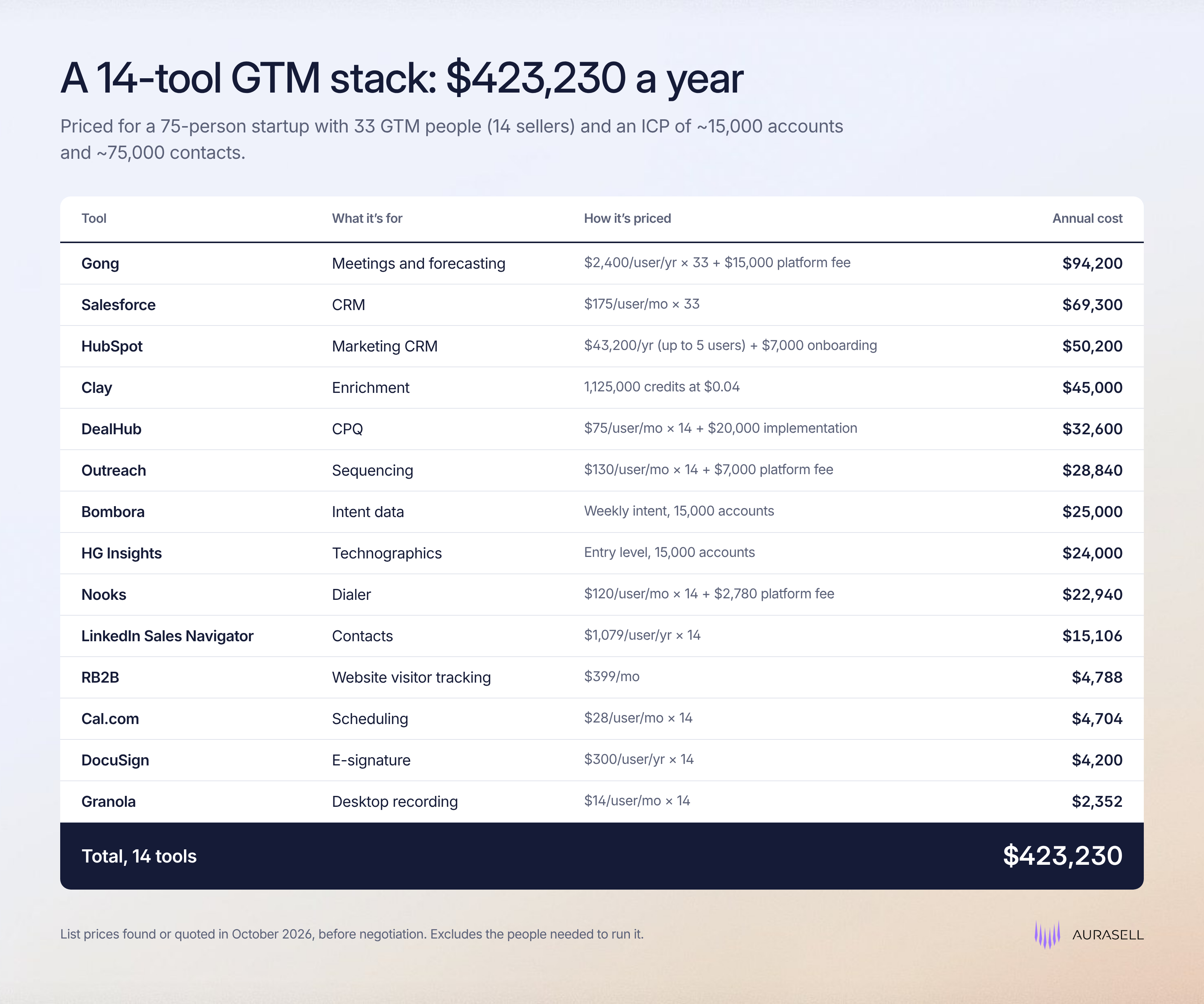
Prices as I found or quoted them in October 2026, before any negotiation. Your numbers will differ, and none of this includes the two people you'll need to run it all.
The invisible cost: what 14 tools do to your data
The $423K is the visible cost. The invisible one is what this tool fragmentation does to your data, and in 2026 that's the one that matters, because for AI to work it needs quality data and context to reason from.
Find me a RevOps leader who doesn't complain about data quality and I'll buy you a pint. Maybe 10 pints. Deduplication, normalization, and unification are hard when your customer and GTM data lives in 14 tools like the ones above.
Here's what that looks like day to day:
- The same person exists five times. One contact lives in the CRM, the enrichment tool, the sequencer, the dialer, and the call recorder, each with slightly different data.
- People get hired to hold it together. Someone has to own the integrations, the field mappings, and the sync jobs that break every time a vendor changes its API.
- Reps become data-entry clerks. Whatever doesn't sync gets logged by hand, or more often, doesn't get logged at all.
- Nobody trusts the number. Forecast calls start with an argument about which tool is right.
The first rule I learned as a software engineer back in 2001 was that remote database calls are slow and expensive. Yet here we are in 2026, with our GTM stack and customer data split across a dozen databases and tool silos.
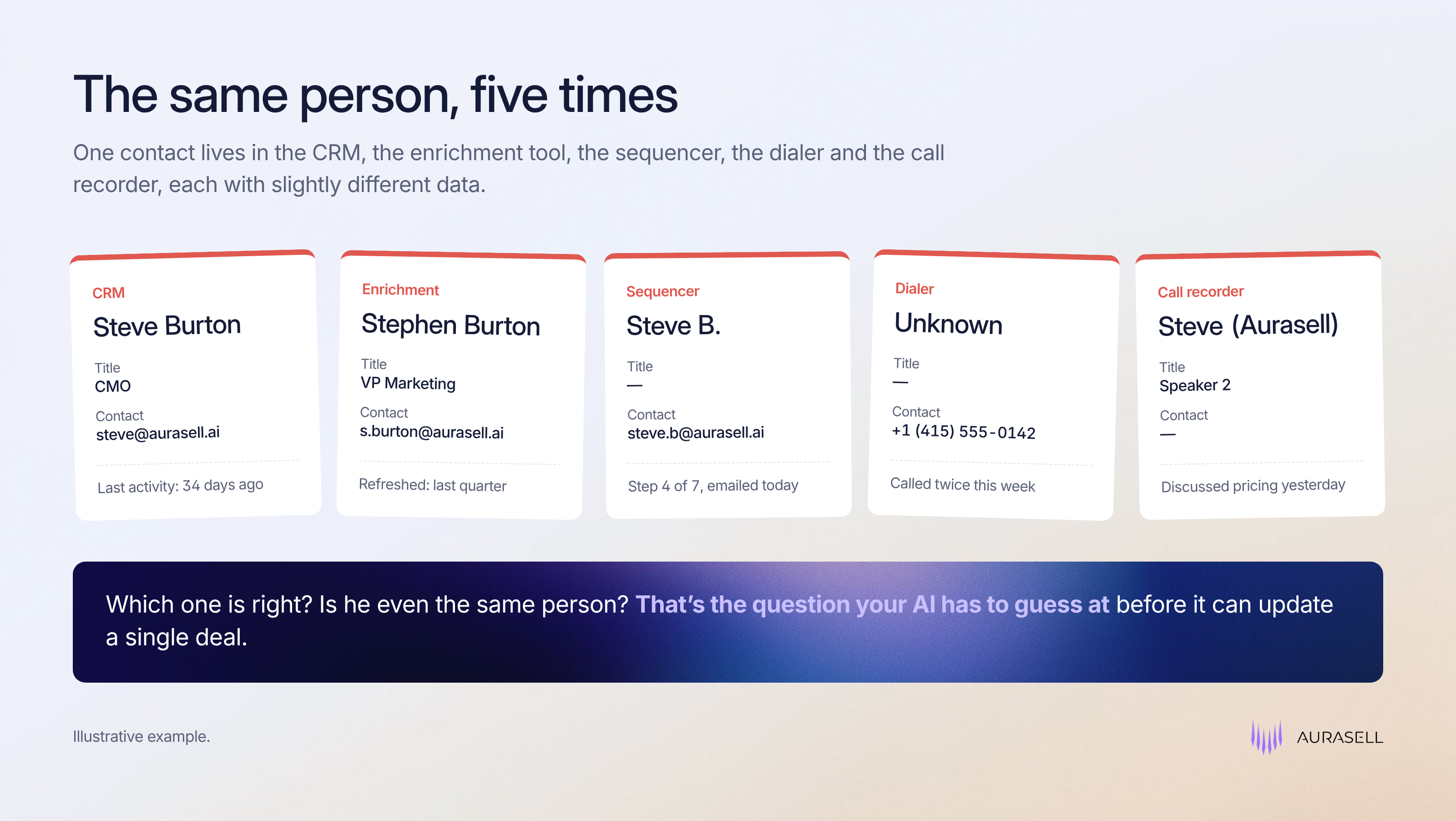
What breaks when your CRM, dialer, and data tools don't talk to each other
The first thing to break is entity resolution: knowing which emails, meetings, calls, texts, and Slack messages belong to which customer and which deal. Lose that, and everything built on top of it breaks with it: activity capture, deal scoring, forecasting, and AI.
Yes, MCP makes it simple for AI to query this data, but like everything, it has limits. Not all customer or GTM data is exposed through MCP and tool APIs.
Say you want an accurate view of a deal based on the latest customer conversations and signals from emails, meetings, voice calls, texts, and Slack. You can't just tell Claude to go query every tool, pull the latest signals, and update your opportunities in Salesforce. Claude doesn't have the context, data fidelity, or entity resolution to work out which of those messages relate to which customers and deals. It's like trying to correlate data in a relational database with 50 different tables and no primary keys.
The promise that AI can magically auto-update your CRM from customer data sitting in a dozen different tools is a stretch. It's a nice vision until you check the data. Missing data or context means AI infers, and when it infers, it sometimes gets things wrong (aka hallucinations).
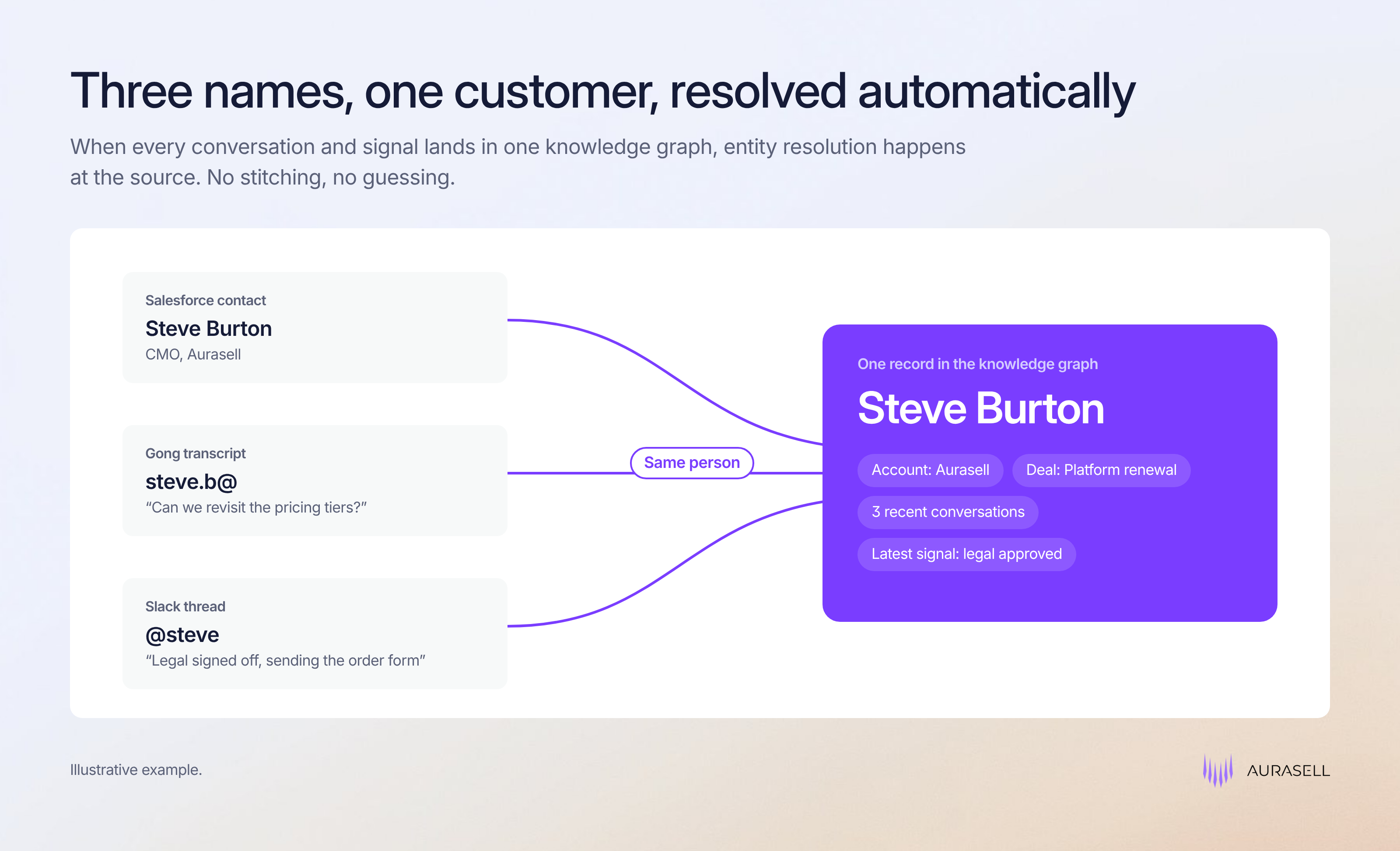
When does a fragmented sales stack start costing more than it's worth?
It tips over when the people and time spent keeping your tools in sync start to rival what the tools themselves cost, or when you can't trust your data enough to let AI act on it. For most teams, that happens long before anyone notices it on a budget line.
You're probably past that point if:
- You've hired, or are about to hire, people mostly to administer and integrate tools.
- The same account or contact shows up in several tools with different data.
- Reps still log calls and emails by hand, or skip it.
- Every point tool now sells its own AI add-on, and each one sees only its own slice of the customer.
- Renewals for different tools land in different months, all year.
- Your forecast call starts with "which number is right?"
Is it realistic to replace your whole sales stack with one platform?
Yes, and you don't have to do it all at once. Most teams we work with start by running Aurasell on top of Salesforce or HubSpot with two-way sync, then retire point tools as their contracts come up. Smaller teams often go straight to replacing the CRM.
It's not risk-free, so here are the real risks and how to handle them:
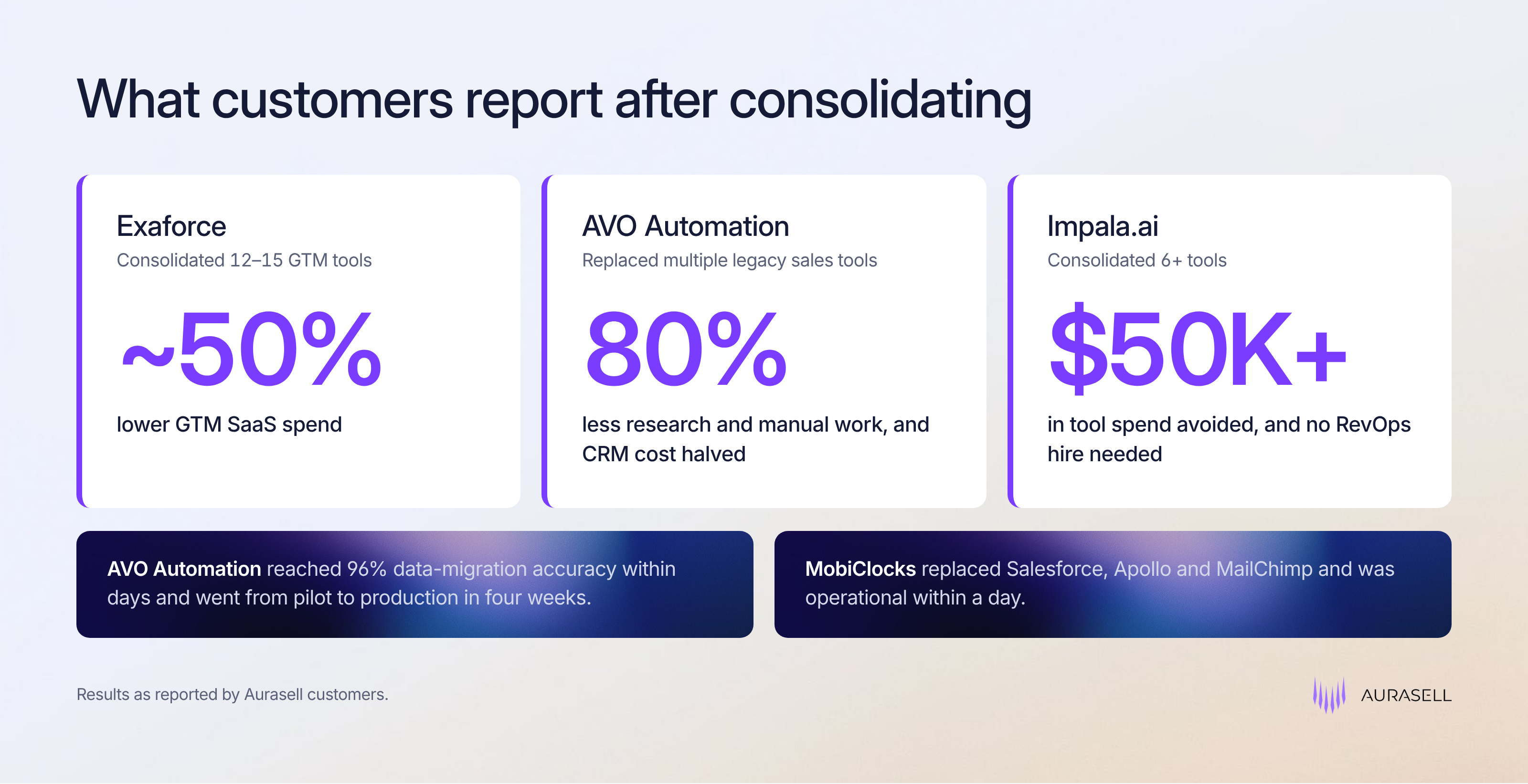
- Migration. Moving data is the part people fear most. AVO Automation reached 96% data-migration accuracy within days and moved from pilot to production in four weeks. MobiClocks replaced Salesforce, Apollo, and MailChimp and was operational within a day.
- Putting more eggs in one basket. Ask any platform how you get your data out, and check its governance. Aurasell is SOC 2 Type II and ISO 27001 certified, with role-based access and row-level security. Your data is yours: export it on demand, or reach it directly through Aurasell's MCP server.
- Depth in a niche. Some specialists go deeper in their own lane. Gong leads conversation intelligence, and Clari leads enterprise forecasting. The question is whether that extra depth is worth a separate silo, or whether you'd rather have one system where every capability shares the same context.
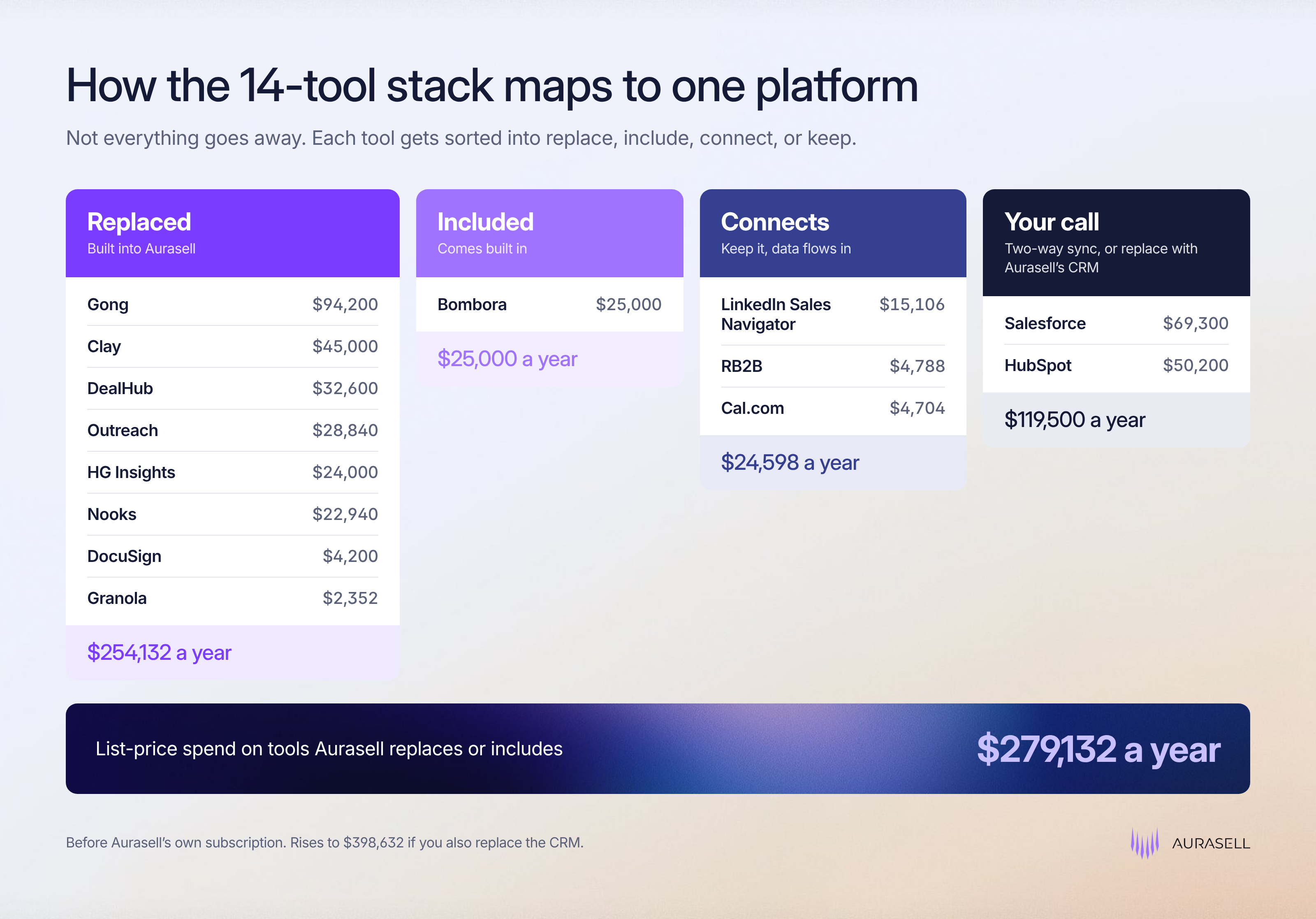
- Not every tool goes away. Some keep running and connect in. For example, Bombora intent data comes included in Aurasell, while website visitor tools like RB2B stay and plug in through one of 40+ integrations.
How to work out the ROI for your own team
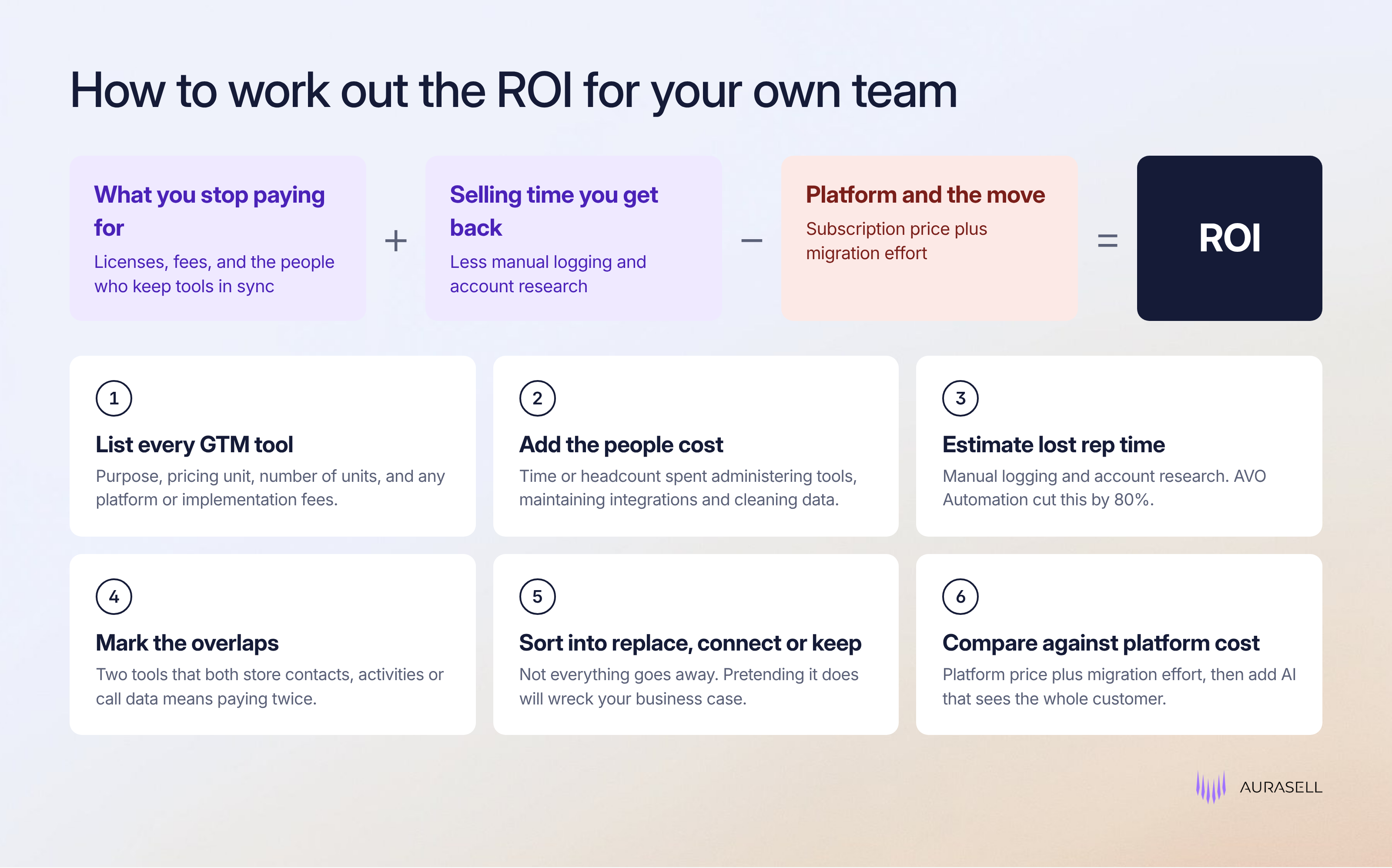
The ROI of one platform is what you stop paying for (licenses, fees, and the people who keep tools in sync) plus the selling time you get back, minus the cost of the platform and the move. Here's how to put real numbers on it:
- List every GTM tool with its purpose, pricing unit, number of units, and any platform or implementation fees, like the table above.
- Add the people cost. Count the time, or the headcount, spent administering tools, maintaining integrations, and cleaning data.
- Estimate the rep time lost to manual logging and account research. AVO Automation cut research and manual work by 80% after moving to Aurasell.
- Mark the overlaps. Any two tools that both store contacts, activities, or call data are paying twice for the same thing.
- Sort each tool into replace, connect, or keep. Not everything goes away, and pretending it does will wreck your business case.
- Compare the total against the platform's price plus migration effort, then add the part a stack of point tools can't buy you at any price: AI that sees the whole customer.
What one platform looks like
Aurasell is an AI-Native Revenue OS: CRM, conversation capture, signals, enrichment, sequencing, dialing, live call assist, forecasting, CPQ, and e-signature on one data model, from contact to contract.
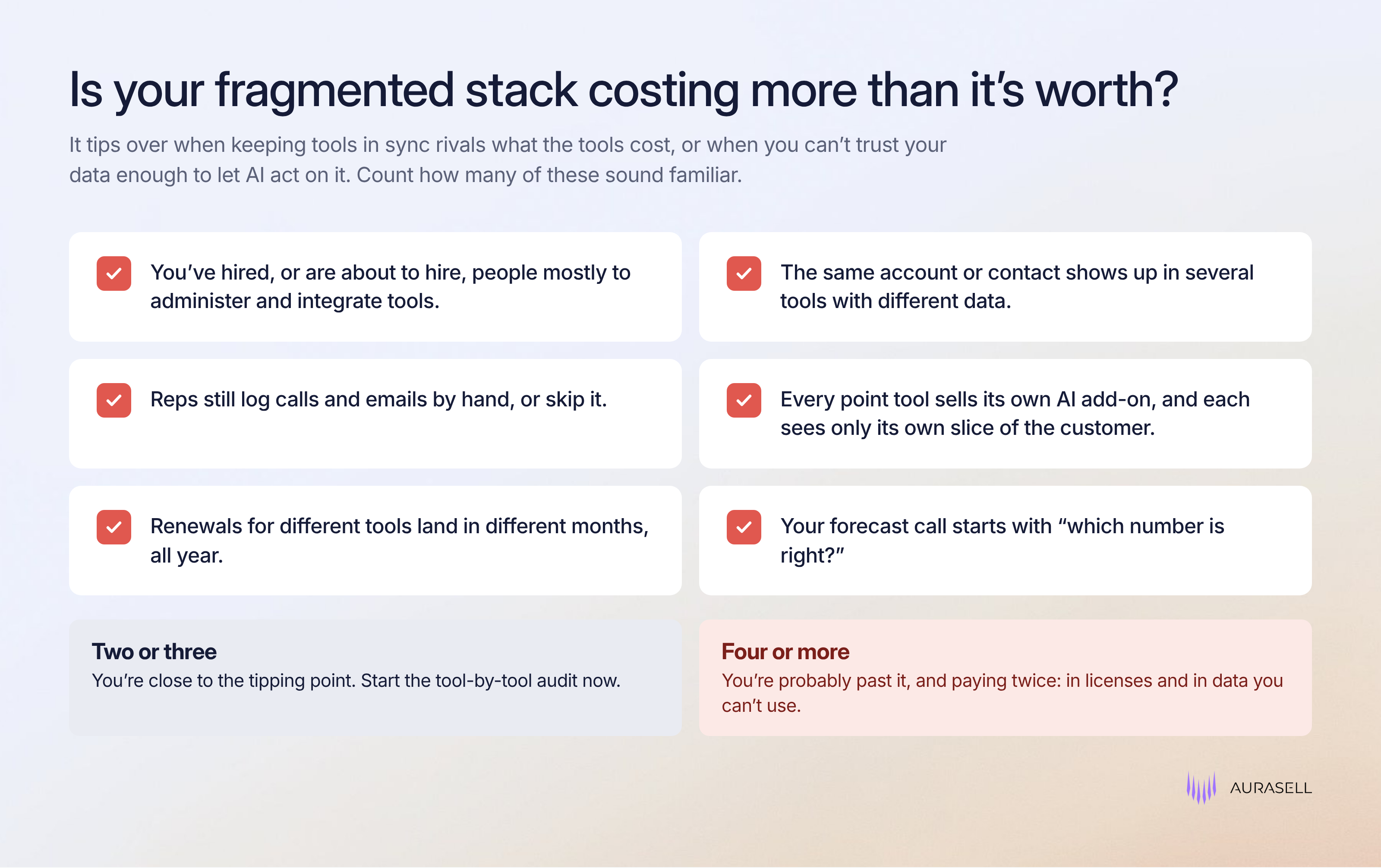
We're trying to solve this exact problem at Aurasell. Instead of 14 tools each holding their own sliver of the truth, every account, opportunity, conversation, and signal lives in one knowledge graph.
So the Steve Burton in Salesforce, steve.b@ in a Gong transcript, and @steve in a Slack thread all resolve to the same person, automatically. No stitching. No guessing. No AI inferring what it can't see. And it doesn't cost $423K for a 75-person company to run.
Here's how the stack above maps to Aurasell:
And here's what customers report after consolidating:
FAQ
What's the real ROI of moving to a single go-to-market platform versus keeping best-of-breed tools?
It comes from two places: the licenses, fees, and admin people you stop paying for, and the data you can finally trust. A 14-tool stack for a 33-person GTM team priced out at $423,230 a year before negotiation, and customers that consolidated onto Aurasell report results like ~50% lower GTM SaaS spend (Exaforce).
What are the upsides of running revenue on one AI-native platform instead of stitching point tools together?
One data model means every email, call, meeting, and signal is already tied to the right account and deal. That gives AI the context to update records, score deals, and forecast without guessing, and it removes the integrations and sync jobs someone has to babysit.
Is it realistic to replace my whole sales stack with one system, and what are the risks?
Yes, if you do it in stages. Start on top of your CRM, then retire point tools as contracts end. The main risks are migration, depending on one vendor, and losing depth a specialist tool offers, so check data export, security certifications, and which tools you'd still connect.
When does a business need a dedicated revenue platform instead of separate sales tools?
When keeping tools in sync takes dedicated people, when the same customer lives in several tools with different data, or when you want AI to act on your pipeline and can't trust the data underneath it.
What breaks when your CRM, dialer, and data tools don't talk to each other?
Entity resolution breaks first: nobody can reliably tie a call, email, or Slack thread to the right customer and deal. Activity capture, deal scoring, forecasting, and AI all depend on that, so they break with it.
How do companies cut sales tech sprawl without losing capabilities?
List every tool, mark where two tools store the same data, and sort each into replace, connect, or keep. Then consolidate onto a platform that covers most of those jobs natively and integrates with the rest.
Bring your stack
If your stack looks anything like the one above, bring it to a demo. We'll go through it tool by tool and show you what stays, what connects, and what you can stop paying for. Or drop me a message. I'd love to show you what we built.