
We pulled twelve months of CRM data to find out what actually kills a deal, and the pattern held with unsettling consistency. By the time a rep downgrades an opportunity or a manager spots the slip, the warning signs have been flashing for weeks. In our cohort, no qualified deal that went a month without a customer reply was ever won. Every dollar the team committed last quarter carried at least one red flag. And the forecast, the number everyone watches, moves last, if it moves at all.
This series breaks down the ten signals that predict a loss, ranked by how hard each one bends the odds. The payoff isn't a longer checklist. The top five red flags double as the five plays that separate winning reps from everyone else.
How to read this series
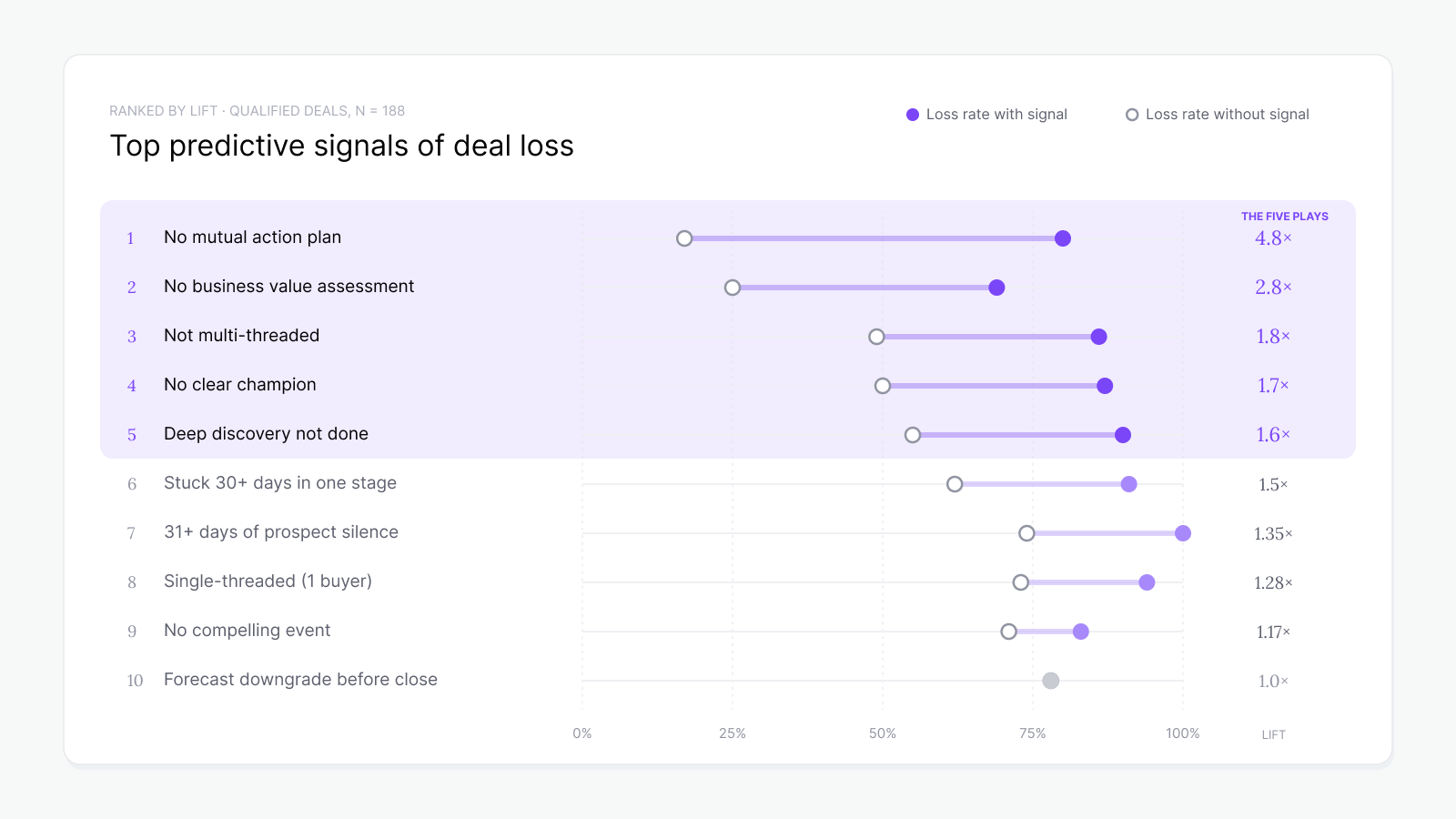
Two numbers set the stakes. The baseline loss rate on qualified deals is 78.2%, so the average qualified deal is already more likely to lose than win. A signal only matters if it moves the odds meaningfully from that starting point. That's why we rank by lift rather than raw loss rate, and why a signal with a 91% loss rate (stuck 30+ days) ranks below one with an 80% loss rate (no mutual action plan).
Methodology
Figures reflect CRM data over the rolling 12 months from August 2025 through August 2026. The cohort is qualified deals: qualified opportunities (pipeline) that reached the qualified stage and, once closed won or lost, fell in-window (n = 188; 78.2% baseline loss rate). We excluded roughly 1,600 early-stage opportunities (default value, no or low activity) so they wouldn't distort the numbers.
Lift = loss rate with a signal ÷ loss rate without it, across this cohort. A lift of 1.0 means no signal. Top-ranked signals exceed the baseline ceiling because their counterfactual (deals that do have a mutual action plan, BVA, or champion) wins well above average. Read them as protective plays rather than warnings.
Small-sample signals are directional. Stakeholder churn was unmeasurable (no events in the cohort). These are single-company results, so treat them as illustrative rather than universal.
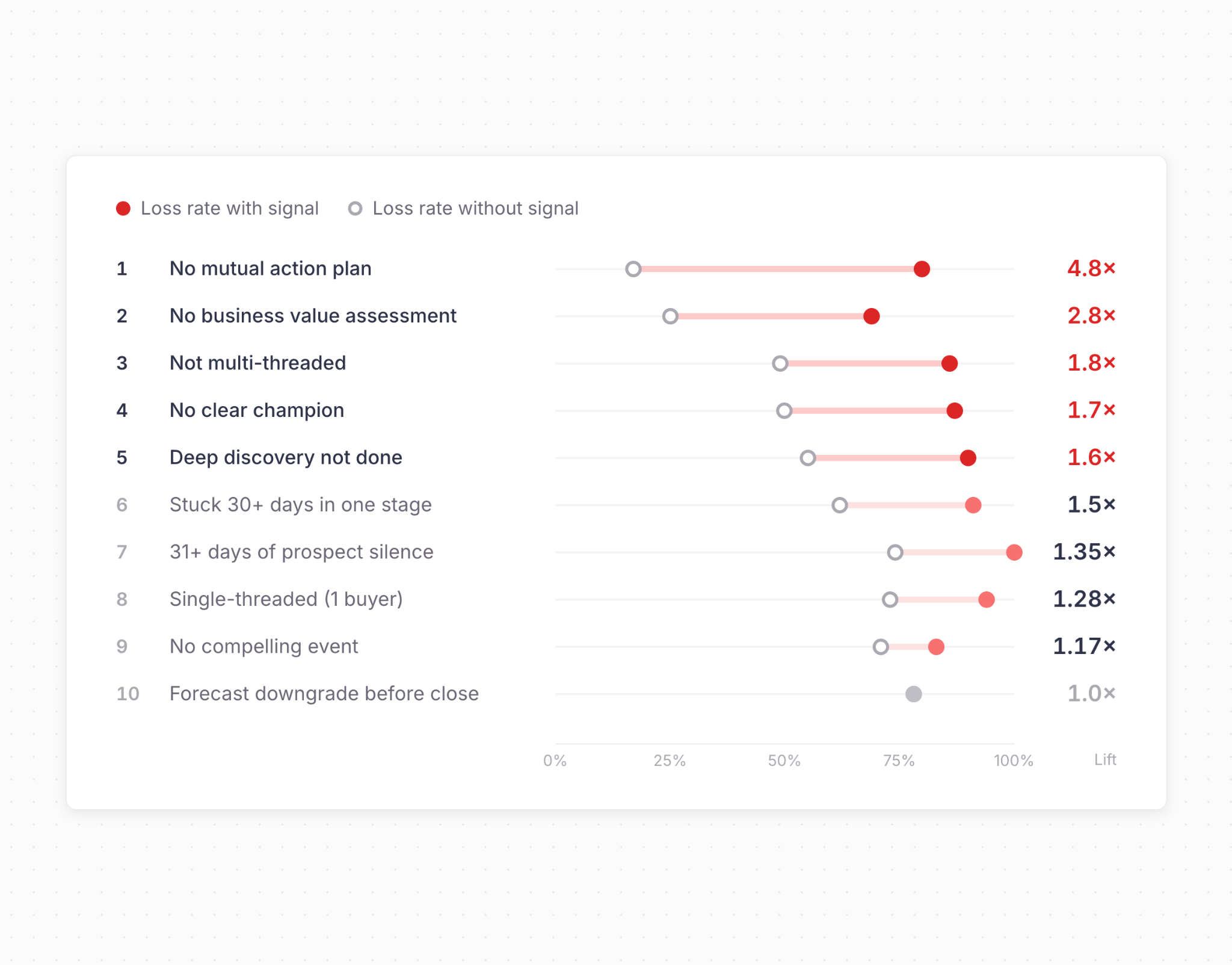
Top Predictive Signals of Deal Loss, Ranked by Lift
What the ranking is telling you
The top of the table is about what reps fail to do. The bottom is about what buyers do. The top five (no MAP, no BVA, not multi-threaded, no champion, no deep discovery) are behaviors a rep can change this week. The signals lower down, like silence and stalls, are symptoms. By the time you see them, the deal is already deteriorating.
Look at the MAP row: 182 of 188 deals had no mutual action plan. Only six did, and one of those six was lost. The 4.8× lift rests on a tiny comparison group, so treat the exact multiple as directional. The finding that matters is that almost no one is building MAPs, and the few deals that had one rarely lost. If you do one thing after reading this, start there.
The framing insight
Each of the top five signals cuts both ways. Every one names a behavior that protects deals when a rep does it well. Stand up a mutual action plan, build a BVA, or land a real champion, and the deal wins far above baseline. Frame these five as the plays that define winning, not just warnings to heed.
What "good" looks like for each of the five plays
- Mutual action plan: A shared, dated plan with the buyer's name next to each step, including legal, security, and procurement. If the buyer never edits it, it's your plan, not a mutual one.
- Business value assessment: A quantified case in the buyer's numbers, ideally reviewed with the economic buyer, not just the champion.
- Multi-threading: Contacts across at least two functions (the user, the budget owner, and a technical or security reviewer), not three people from the same team.
- Champion: Someone with influence who has done something for you, such as sharing internal information, making an introduction, or pushing back on your behalf. Friendliness doesn't count.
- Deep discovery: The buyer's cost of doing nothing, written down in their words.
Deep Dives
Single-threading is a slow-motion loss
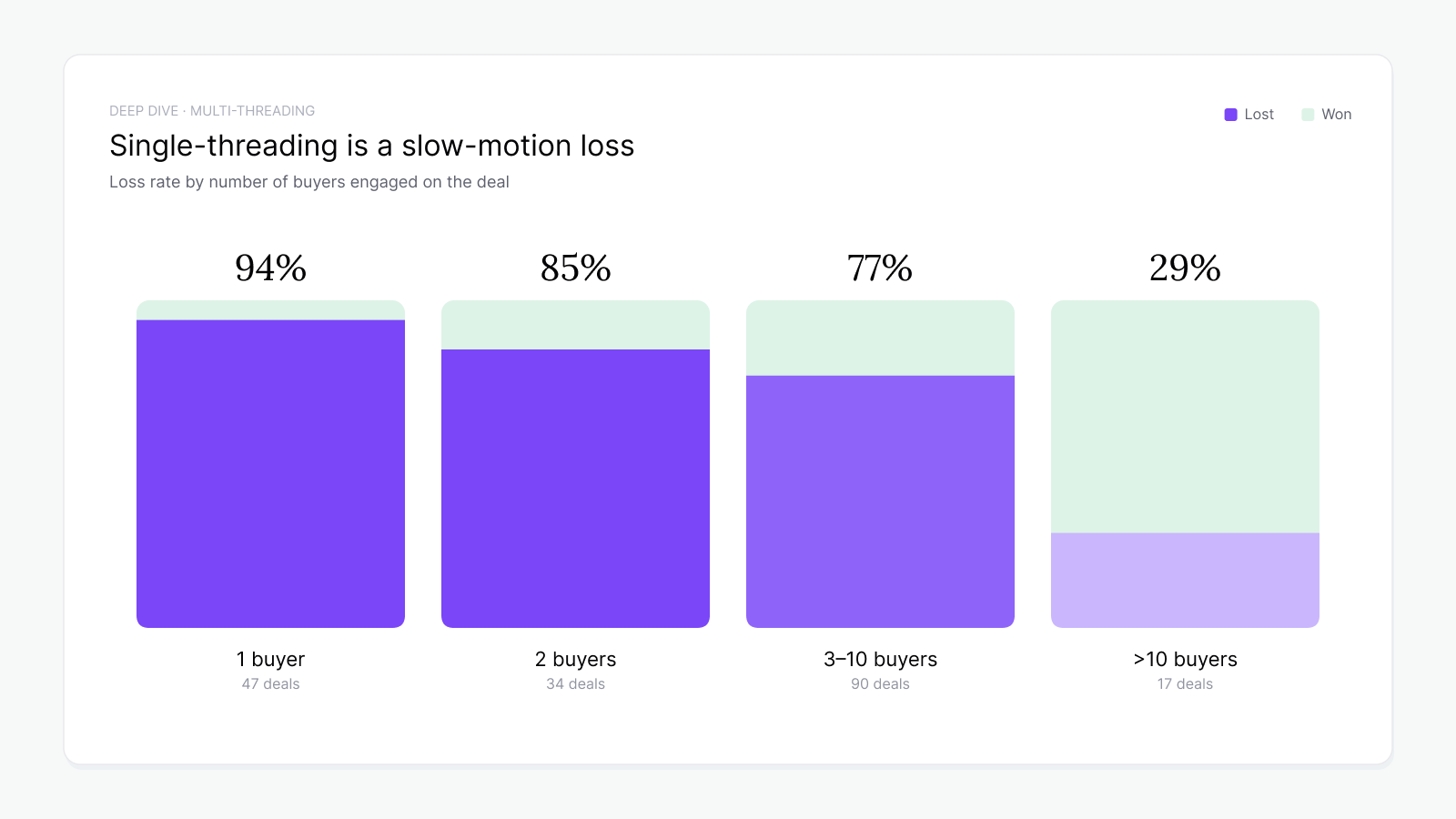
Every stakeholder you add lowers the loss rate. Single-threaded deals lose 94% of the time. Deals with a real buying committee (more than 10 people) win about 70% of the time. This is the cleanest chart in the pack.
Look at the size of each step. Going from one buyer to two cuts the loss by 9 points (94% to 85%). Going from two to a 3–10 person group cuts it by another 8. The big drop, 77% to 29%, only comes past ten people. Adding a second contact isn't the fix. The fix is getting the deal in front of a real committee.
Some of this is probably reverse causation. Healthy deals attract more stakeholders as they progress, so a big buying group is partly a symptom of a deal going well. The practical takeaway still holds, though. Wide engagement is something you can pursue deliberately instead of waiting for it to happen. And only 17 deals sit in the >10 bucket, so don't quote 29% as a promise.
Days of prospect silence before a likely loss
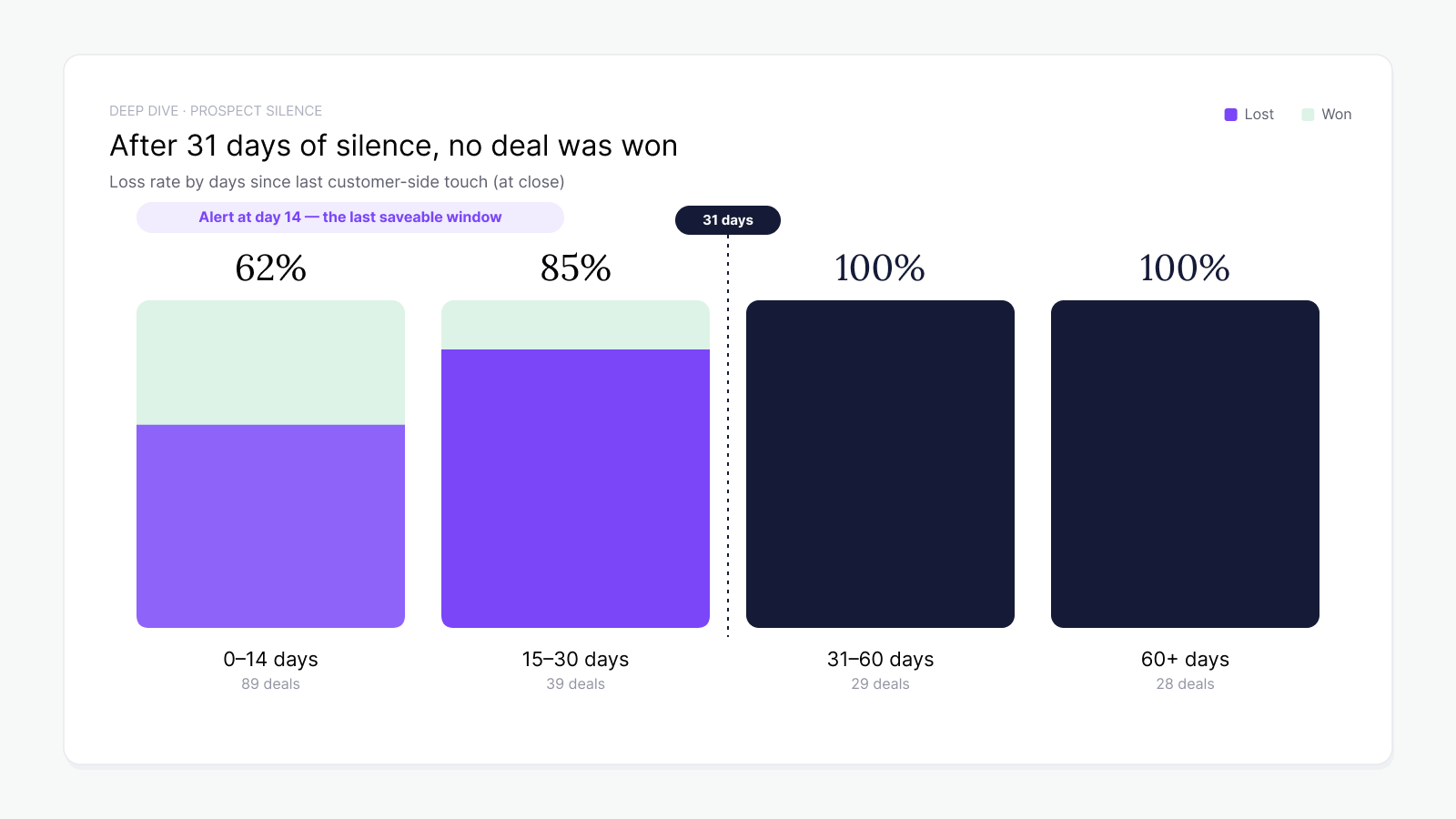
The threshold is 31 days. Once a qualified deal in our cohort went 31 or more days without a customer-side interaction, it closed lost every time. After a month of silence, the deal is effectively dead and the CRM just hasn't caught up.
Your alert should fire at day 14, not day 31. The 31-day cliff makes a great headline, but it's a post-mortem line. The more useful number is the jump between the first two buckets: loss rate climbs from 62% to 85% once a deal passes two weeks without a customer-side touch. That 15–30 day window holds 39 deals, and it's the last stretch where a deal is still saveable.
When a qualified deal hits day 14 with no customer response, the rep changes channel (a new contact, a different medium, an exec-to-exec note), and the manager sees it. Waiting until day 31 means you're documenting a loss, not preventing one.
One more point on the 0–14 bucket: even deals with recent contact lose 62% of the time. Activity isn't the same as progress. A reply from someone who can't buy is still a reply.
Champions: the strongest human signal
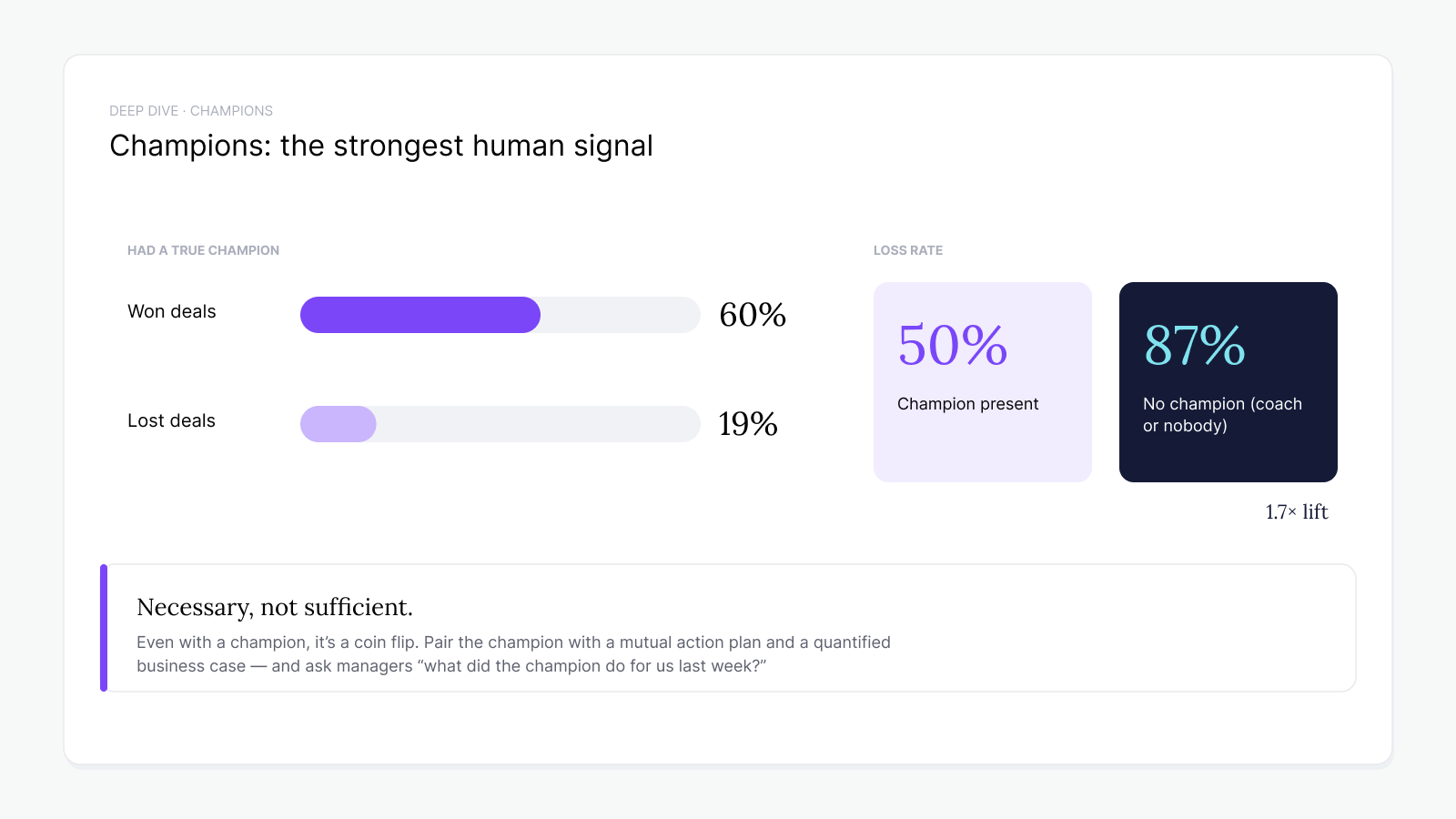
Champion is necessary, not sufficient
Even with a champion on the deal, the loss rate is 50%. That's far better than 87%, but it's still a coin flip. A champion gets you into the building. A mutual action plan and a quantified business case are what let that person carry the deal across the line without you in the room. Pair the plays: a champion without a MAP or BVA is a hopeful relationship, not a deal.
If completion scores barely differ between won and lost deals, scorecards are measuring rep diligence, not buyer commitment. A useful test for managers is to stop asking "is the field filled in?" and start asking "what did the champion do for us last week?"
Stage stagnation and velocity
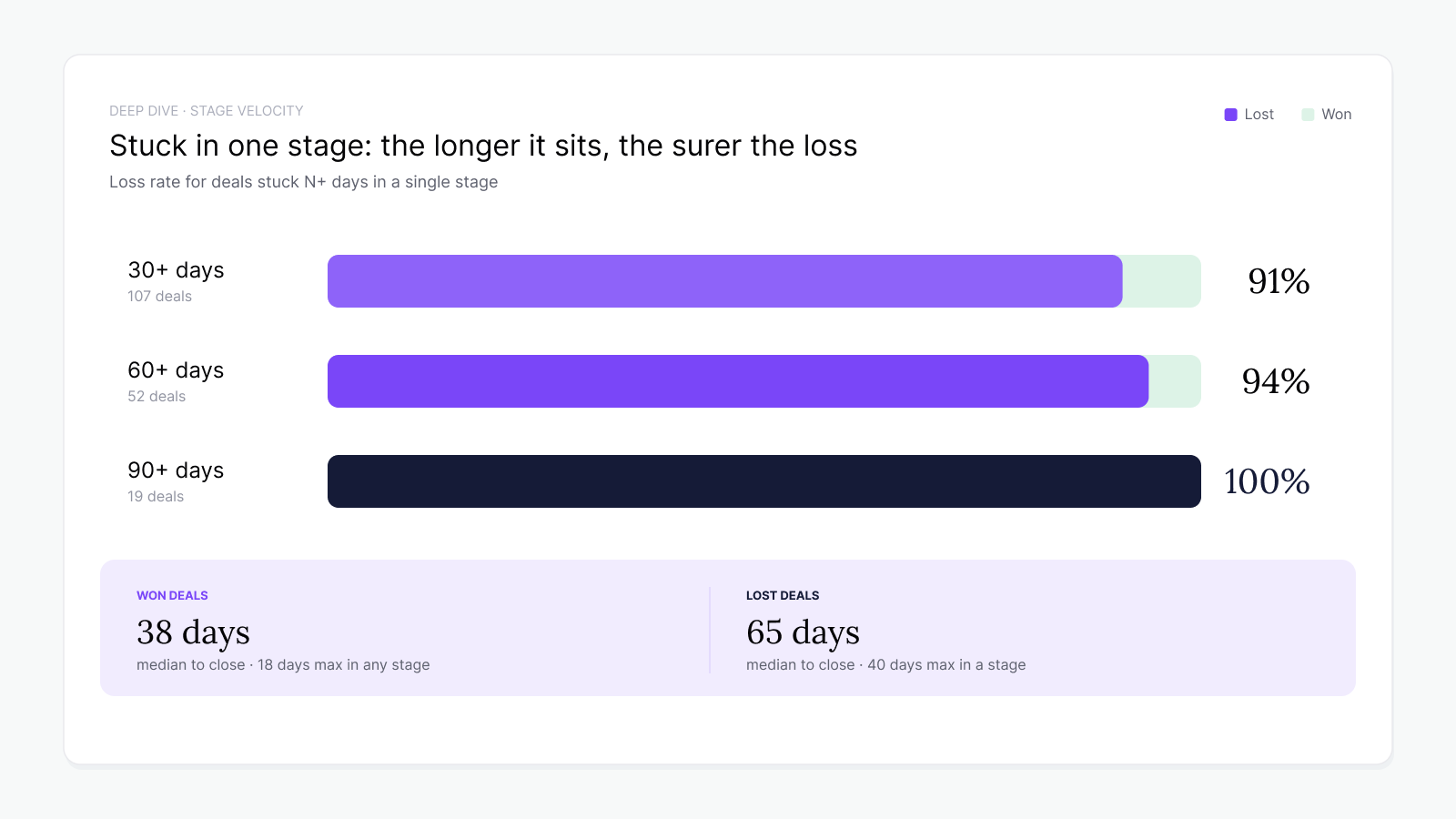
- Won deals: median 38 days to close, 18 days max in any one stage.
- Lost deals: median 65 days, 40 days max in a stage. Losing deals take roughly 1.7× longer overall and sit stuck about 2× longer. Thirty days in a single stage is your early-warning line.
Why 30 days is a late warning
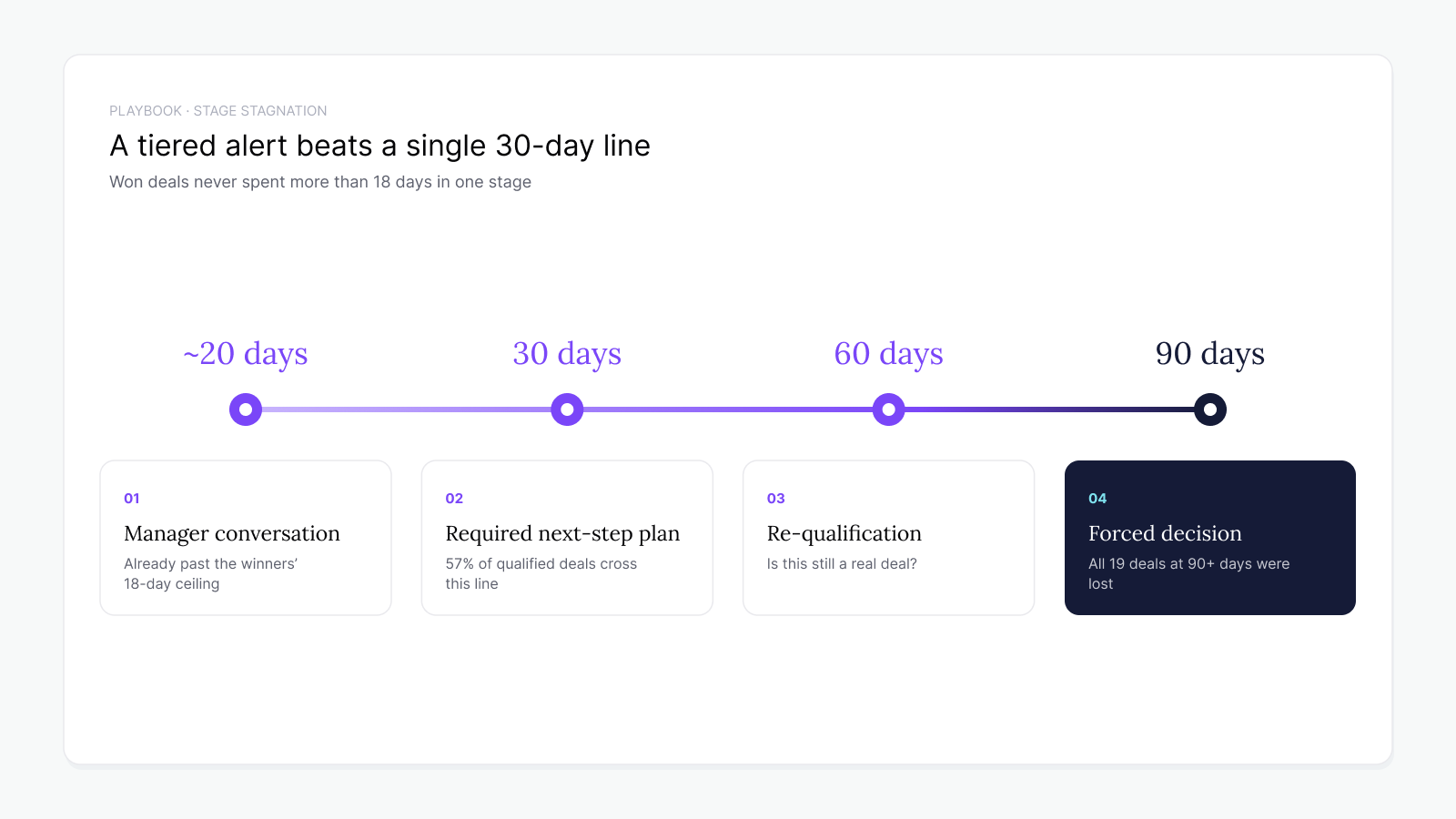
Thirty days in a single stage is the line most teams use, but the data suggests an earlier one. Won deals never spent more than 18 days in any one stage, so 30 days is already well past the winners' ceiling. Also note that 107 of the 188 qualified deals (57%) crossed the 30-day mark. A flag that fires on more than half the pipeline stops being a flag.
A tiered approach works better:
Team-level flags (pipe concentration and aged coverage)
Across reps with 8 or more qualified deals:
- Coverage built on aged deals is the dominant team risk. Some reps carry 50 to 85% of their open qualified pipeline in deals that are more than 90 days old or already past their own close date. That's coverage on paper, not coverage in reality.
- Pipeline concentration (one deal making up a big share of the pipe) topped out around 35%. No rep crossed the 40% danger line, so this isn't the team's primary risk. Worth stating anyway, since it sets reader expectations.
- Commit hygiene is universally poor. For every rep with commit-category deals, 100% of committed pipeline dollars carried at least one red flag (single-threaded, silent, or no champion). Every dollar your team committed last quarter had a red flag attached to it.
Three quick audits for managers
- Recalculate coverage without aged deals. If a rep shows 3× coverage and 60% of it is 90+ days old or past its close date, real coverage is closer to 1.2×. And with a ~22% win rate on qualified deals, even a clean 3× is thin. At that rate you'd need roughly 4.5× qualified coverage to hit the target. (This assumes dollar win rates resemble count-based ones, so check your own.)
- Gate the Commit category. Since every committed dollar carried a flag, require a few things before a deal can be labeled Commit: a customer touch in the last 14 days, at least two threads, a named champion, and a MAP. If it can't pass, it's Best Case. The category should mean something.
- Review by signal, not by stage. A weekly inspection ordered by number of open red flags will surface the real risks faster than one ordered by amount or close date.
Bonus insight: forecasts die quietly
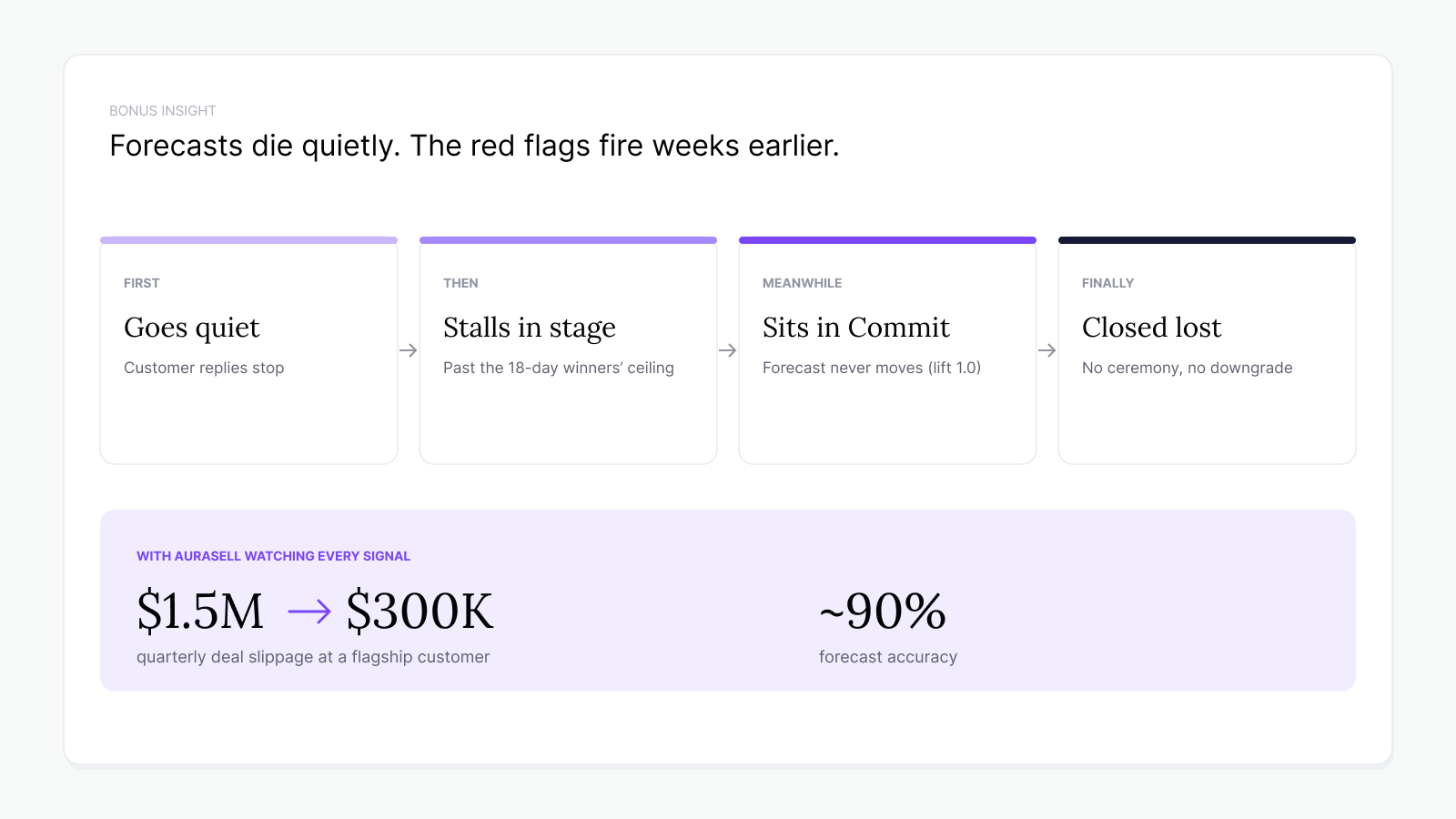
Forecast downgrades do not precede loss (lift 1.0, no signal at all). Reps almost never de-commit a dying deal. Combine that with a deal going silent and stalling in-stage, and you get the through-line for the whole piece:
Deals rarely get downgraded. They go quiet, stall in an optimistic forecast bucket, and close lost without ceremony. The red flags fire weeks before the forecast ever moves.
What this means for forecast calls. A lift of 1.0 means the downgrade carries no predictive information: deals that were downgraded lost at the same 78% as those that weren't. If your forecast review is driven by category changes, you're inspecting the one thing that doesn't predict outcomes. Replace "has the category changed?" with "have the flags changed?" and you'll catch deals weeks earlier.
Tying the Data to Aurasell
These are a few examples of how Aurasell catches all of this automatically:
- Champion Departure Signal: Maps to signals #3 (not multi-threaded) and #4 (no clear champion).
- AI Forecast Predictions: Automatically downgrades a Commit deal to Pipeline when it detects weak engagement or missing qualification, doing the de-commit reps skip and fixing signal #10's (forecast downgrade before close) blind spot.
- Deal-risk indicators on account and contact timelines: Fast deal progression, unengaged associated contacts, and missing champion, economic buyer, or timeline.
- MEDDPICC auto-capture from emails and meetings, plus an Opportunity Quality Score: Surfaces the quality gap behind signal #4 (no clear champion).
- Meeting Companion: Captures risk signals and MEDDPICC live on calls.
- PTES (Propensity to Engage Score) and Signals: Quantifies buyer silence and engagement (signal #7, 31+ days of prospect silence).
The Bottom Line
Every red flag in this report shares one trait: it shows up long before the deal officially dies. Silence, a stalled stage, a missing champion, a committed number nobody de-risks. The signals sit there for weeks. What's usually missing is someone watching for them while there's still time to act.
That's the real cost. Not the deals you lose, but the deals you could have saved if the warning had reached you in week two instead of week eight. A rep carrying forty open opportunities can't manually track thirty-one days of silence across every one. A manager scanning the roll-up sees Commit, not the single-threaded, silent, championless reality underneath it.
This is where Aurasell earns its place. It watches every deal for all ten signals at once, flags the champion who just went quiet, downgrades the Commit that no longer deserves the label, and surfaces the risk while the deal is still winnable. One of our flagship customers used it to pull deal slippage from $1.5M to $300K a quarter and push forecast accuracy to near 90%.
The red flags will keep firing whether or not anyone is looking. The only question is whether you catch them in time to change the outcome.