

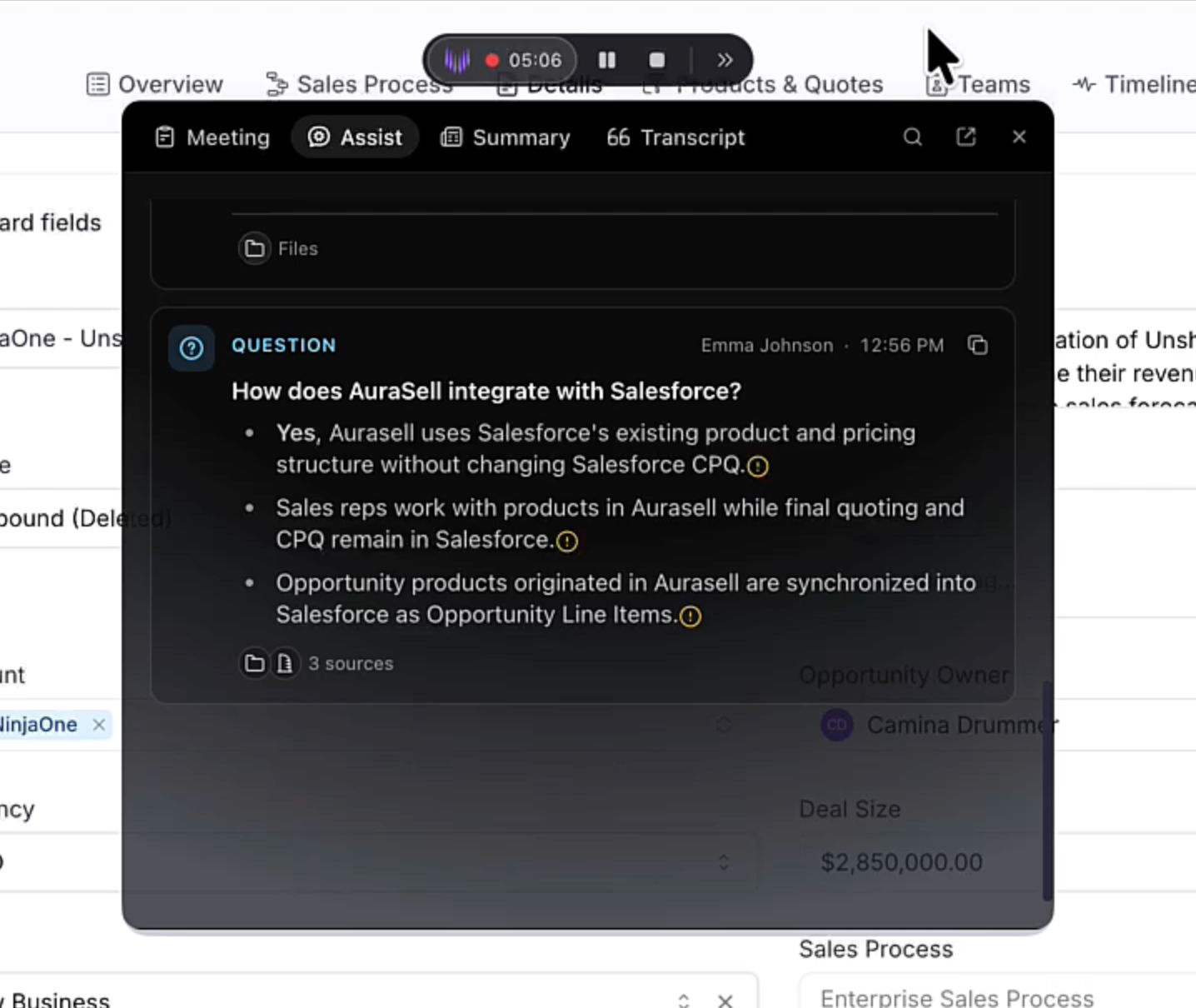
Picture this, a rep is five minutes into a great call. The buyer is nodding. Then the buyer asks, "Do you support forecasting? And does it work on top of Salesforce?" A totally normal question. The rep doesn't know the answer.
"Let me get back to you"
The deal doesn't die right there, but the rep's credibility with the customer starts to.
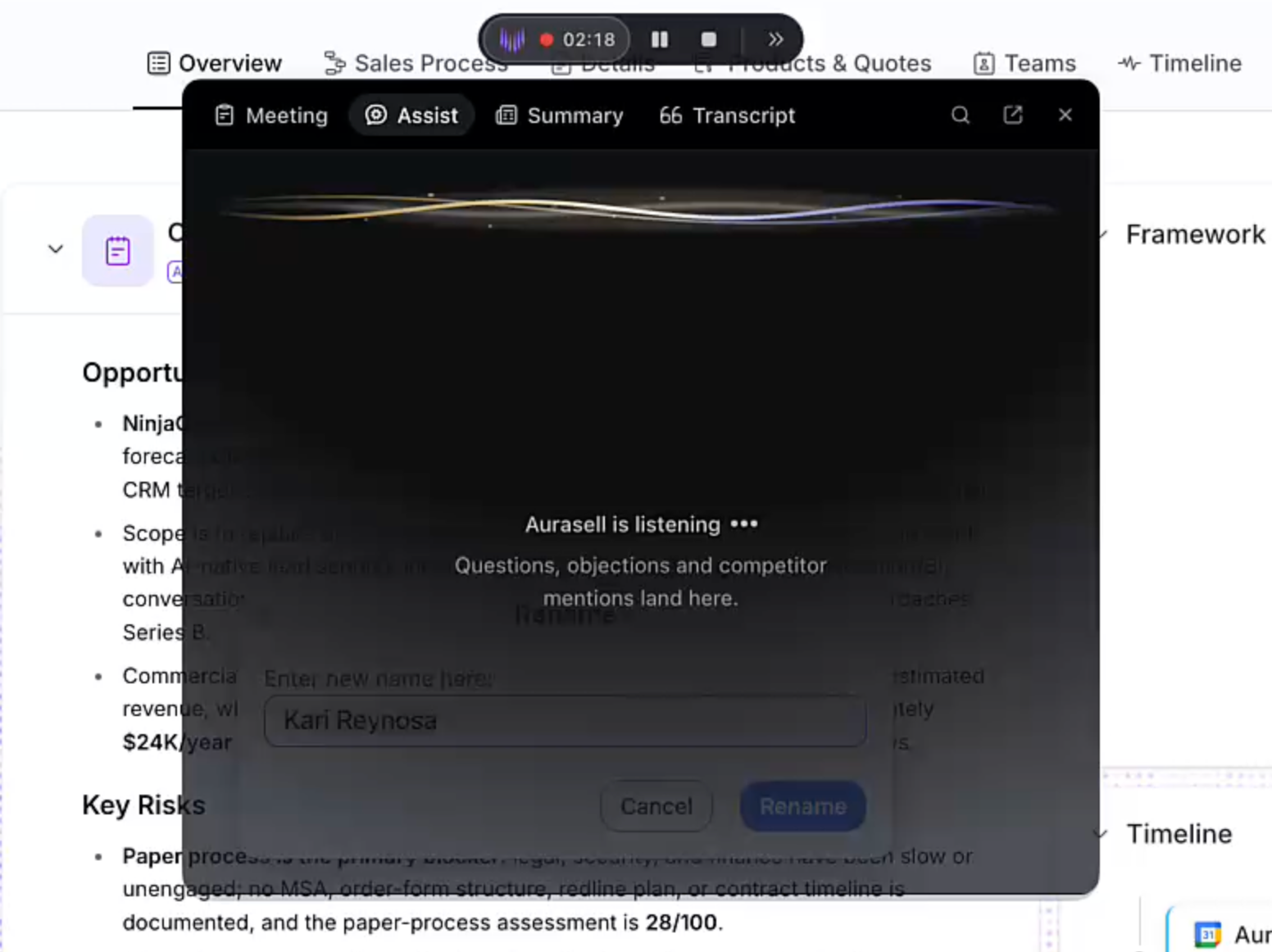
That little moment or hesitancy is why we built Aurasell Live Assist. It rides along on the live call, listens in, and hands the rep the right answer before the buyer even notices.
Okay but isn't this just... search?
This is the question every engineer asks on day one, right before they get humbled. The naive version sounds easy: hear the question, grep the knowledge base, return a sentence. Ship it, go to lunch.
Except buyers don't ask tidy, FAQ-shaped questions. Nobody says "what capabilities do you have for enterprise security?" They say something like "we have a strict security review process, will your product meet our requirements?" Same topic, completely different problem. One is a keyword search. The other needs you to know who's asking, what account they're from, what's already been discussed, and which of your fifty security docs is actually relevant to them. Hand that buyer a generic doc snippet and you look like a chatbot that skipped the onboarding call. Worse than silence, honestly.
And this is kind of embarrassing if you think about it: every sales org already has a CRM, a call recorder, and a knowledge base. Surely one of those should've solved this by now? Not really, a CRM is built to manage records, a call recorder is built to capture audio, and a knowledge base is built to sit there and store things nobody reads until Q3. None of them were built to understand a live conversation and hand the right fact into it while it's still happening. They're all very good at their jobs. Their jobs just aren't this one.
So the actual input isn't a question. It's a question related to a contact, an account, and a whole history of signals. Early on, the team deliberately ditched the "let's build an AI chatbot for reps" framing, too small, too generic, too much like every other copilot bolted onto a CRM in favor of something closer to "let's build a real-time intelligence layer around the conversation itself." That's a mouthful, but it's the right mouthful, because it's the difference between a tool that answers questions and a tool that's actually paying attention.
Live Assist fuses three things together in real time:
The live conversation happening right now, the context graph of the contact and account who are on the call, and the knowledge base that actually has the answers — all kept fresh as new calls, emails, and signals roll in.
We’re not trying to answer every sentence anyone says on the call. Live Assist listens specifically for the buyer's questions, the ones that matter, and ignoring the rest.
The context piece is also the unglamorous but load-bearing part. Context has a shelf life shorter than office pizza. One new email, one competitor move, and yesterday's "complete" account picture is stale. So Aurasell is always listening, watching conversations, signals, and documents so the answer a rep gets in month six is smarter than the one they'd have gotten in month one.
The two second latency challenge
Here's the twist, being right is the easy part. Being right fast enough is where Live Assist became challenging. Early versions were landing answers in 8–10 seconds, which sounds fine until you realize that in an actual conversation, 8 seconds is an eternity. So the team threw out the comfortable number and set an uncomfortable one: under two seconds, or it doesn't count.
The rule of thumb
Past about two seconds, a live assist stops feeling like a conversation and starts feeling like you put someone on hold to Google something. Which, respectfully, is exactly what it would be doing.
Naturally, our first instinct was "throw the biggest, smartest frontier model at it." Reasonable idea. Also, a dead end. The big flagship models are brilliant and also kind of slow movers, like a genius who needs a solid ten seconds to find their car keys. Great answers, wrong decade.
So the team flipped the approach: start small and fast, then make it smart, instead of starting smart and trying to make it fast. That meant trawling through a pile of open-weight models, picking ones that punched above their weight, and fine-tuning them hard for this one specific job rather than asking them to be a generalist.
At the same time, the platform team was over in the corner doing the unsexy-but-crucial work of matching those models to the right GPUs, not the cheap instance that chokes under load, and not the absurdly overpowered compute that burns money for no extra speed. We landed somewhere in the middle. The resulting pipeline does four things back to back: catch the buyer's question as it's spoken, figure out what's actually being asked, pull the relevant slice of context and knowledge, and generate a response, all inside that two-second window, depending on how complex the question is.
And to be clear, you can’t do this with just hardware or just a model. Fast hardware running a sloppy model just gives you wrong answers quickly, which is somehow worse. A great model on the wrong hardware just times out politely. The only reason this actually works is that the model folks and the infrastructure folks treated it as one problem the whole way through, instead of tossing a model over the fence and hoping for the best.
So what does a rep actually get out of this?
The obvious win is that reps stop punting and start answering, so calls keep rolling instead of stalling out on a vague promise to "circle back." The sneakier win is what it does to ramp time. Normally, confidence on a call is basically a tenure chart, the AE who's been doing this for years just knows stuff, and the new SDR is winging it. Live Assist flattens that curve, because the knowledge isn't something you had to accumulate scar tissue to earn, it's assembled live, every time, from verified sources.
In practice, that means the SDR on their first day and the AE celebrating their ten-year work anniversary can field the exact same "does it work with Salesforce" question with the exact same confidence and the exact same speed.
Aurasell just quietly erased the gap between "I've done this a thousand times" and "I started on Monday." And because the knowledge Live Assist hands back is the company's own — not generic AI trivia scraped from the internet — a rep isn't getting a plausible-sounding guess. They're getting what the organization actually knows, delivered at the one moment it's useful.
When it shrugs (and why that's actually fine)
Sometimes Live Assist won't have the answer. Those gaps get logged and fed back into the knowledge base, so the next rep who hits that same question doesn't hit the same wall.
There's also a "readiness layer" on the roadmap, the idea being you could point it at a batch of recent calls before a rollout and get back something like a report card: here's roughly what percentage of real buyer questions your current knowledge base could actually have answered. Which is a much more honest number than "we have a knowledge base" and a shrug.
Learning Execution Excellence
Helping one rep on one call is the easy version of the pitch. The more interesting version shows up once you stop looking at calls one at a time and start looking at the last thousand of them together. Suddenly you can see which questions buyers ask constantly, which ones your team answers with total confidence, where the knowledge gaps actually live, which competitors keep getting name-dropped, which objections are creeping up month over month, and which parts of the product buyers just can't seem to wrap their heads around.
Feed all of that back into the system continuously and you get a loop instead of a one-off tool: conversations create questions, questions reveal gaps, gaps get filled, filled gaps make the next conversation better. Rinse, repeat, compound. That's the actual bet here, not "give reps a slightly faster search bar," but turn every sales call the company has ever had into a living, self-improving source of organizational knowledge.
Nobody needed another copilot nagging them mid-call. The point was always simpler: the best answer to a buyer's question shouldn't have to wait until after the meeting. Sometimes the whole win is just never having to say it "let me get back to you" ever again.